Feeling behind on pop culture is exhausting. Everyone seems to know the new show, the new song, the new trend, and you're still on chapter four of a book you love. If you're a slow reader, here's the good news: going deep is not falling behind. It's a different way to keep up, with yourself.
Quick answer
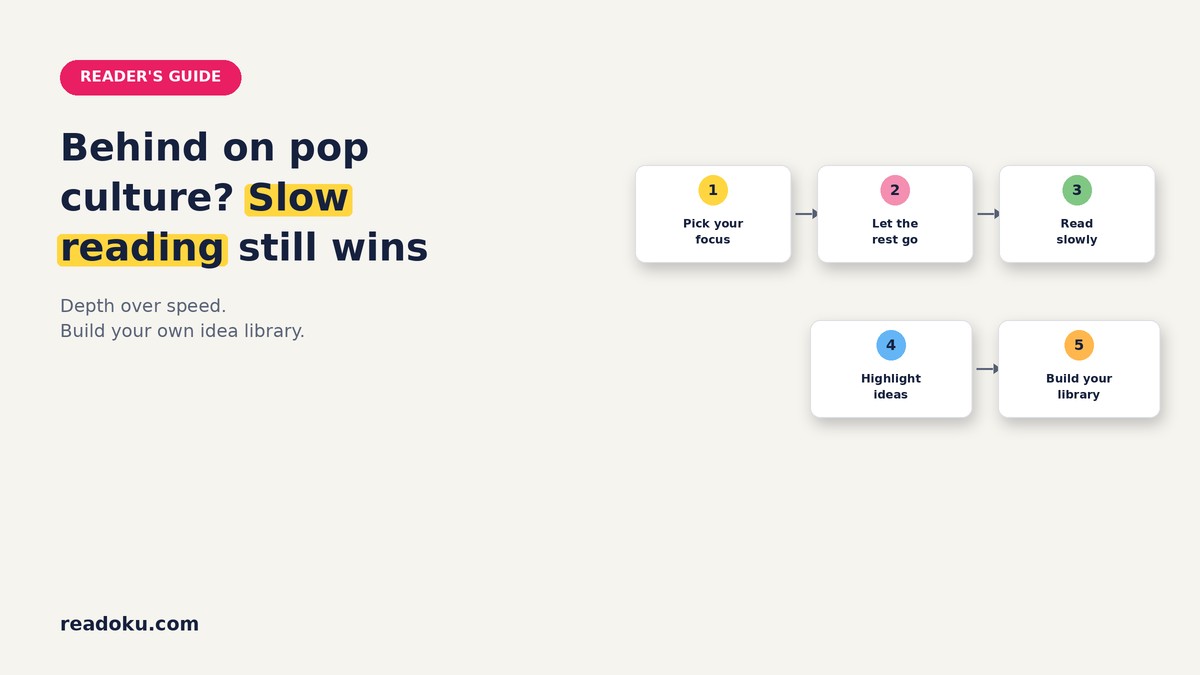
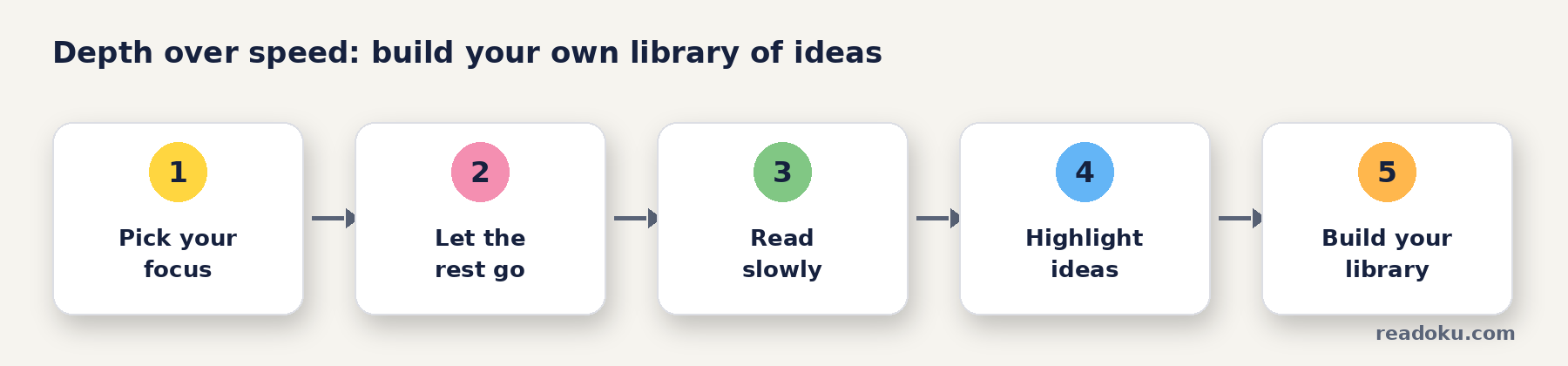
- Name the feeling: it's often a fear of missing out, not a real loss.
- Choose one or two areas you truly care about.
- Let the rest go, on purpose.
- Read slowly and save your best ideas as highlights.
- Build your own library of ideas you can return to.
Why does falling behind on pop culture feel so bad?
Humans are social. When everyone talks about something you haven't seen, it can feel like being left outside the room.
Researchers call this the fear of missing out: a worry that others are having rewarding experiences while you're absent. One well-known study linked it to lower feelings of competence, autonomy and connection in daily life (Przybylski et al., 2013). In plain words, the feeling is real and common. But it says more about how fast the world moves than about your worth.
Is being a slow reader a problem?
No. Slow reading often means you are thinking while you read. You notice details, ask questions and make connections. That's exactly what deep learning needs.
Fast culture rewards being first. Reading rewards being present. Both are valid, but only one builds knowledge that lasts.
How do you stop chasing every trend?
- Write down what you really care about. Two or three topics, for example "climate history, poetry, my thesis field".
- Pick one "light" source for the rest. A short weekly roundup is enough to follow conversations without drowning.
- Set a feed limit. For example, 20 minutes in the evening, after your reading is done.
- Read one thing deeply each week. A chapter, an essay, a paper. Finish it slowly.
- Say it out loud: "I don't need to know everything. I need to know some things well."
What does depth give you that speed doesn't?
- Real conversations. People enjoy talking to someone who knows a topic well.
- Better grades and writing. Deep reading gives you quotes, arguments and examples.
- Calm. You stop measuring yourself against an endless stream.
- Ideas that last. Trends fade. Good ideas keep being useful.
If motivation is the hard part, see how to increase your motivation for reading.
How do you build your own library of ideas?
Here's where slow reading pays off. Instead of letting ideas disappear when you close a book, collect them.
- Highlight the lines that move you. Use yellow for ideas and pink for quotes you want to keep.
- Add a short comment. One sentence: why does this line matter to you?
- Extract your highlights. Upload the PDF at readoku.com/extract-highlights and download them as Word, Excel, JSON or Text, with page numbers.
- Keep one growing file per topic. Over months, this becomes your personal library: your ideas, your words, your pace.
- Tag your files and folders by topic, so you can find them again in seconds.
Want a full system? See from PDF highlight to idea system.
What can you say when you haven't seen the thing?
You don't need to fake it. Try:
- "I haven't seen it yet. What did you like about it?"
- "I'm deep in a book right now. Can I tell you about it?"
Curiosity connects people more than being up to date.
Good to know
- Sign-in required to upload. Free accounts get 3 uploads in total. There is no free trial.
- Exports: Word, Excel, JSON, Text and copy to clipboard. Several PDFs download together as a ZIP.
- Price: EUR 2/month or EUR 12/year (EUR 1/month, 50% off), with a 14-day refund.
FAQ
Is it okay to ignore trends completely?
Yes, if that feels good. Many people choose a middle path: one short roundup a week and deep reading the rest of the time.
How can I read faster without losing depth?
Read with a clear question and skip what doesn't answer it. Speed often comes naturally once you know what you're looking for.
Will I feel left out at first?
Maybe, for a while. Notice the feeling, let it pass and return to your book. It usually gets lighter with time.
What should I highlight in a novel or essay?
Lines that surprise you, explain an idea clearly or that you'd like to quote. Keep it to a few per chapter.
Start your idea library today
Pick the book or paper you love most right now. Highlight five lines that matter to you, extract them and save them in your first library file.