Learning how to critically evaluate a research article is easier with a short list of questions. Ask them while you read, mark the answers in the PDF, and your critique is half written.
Quick answer
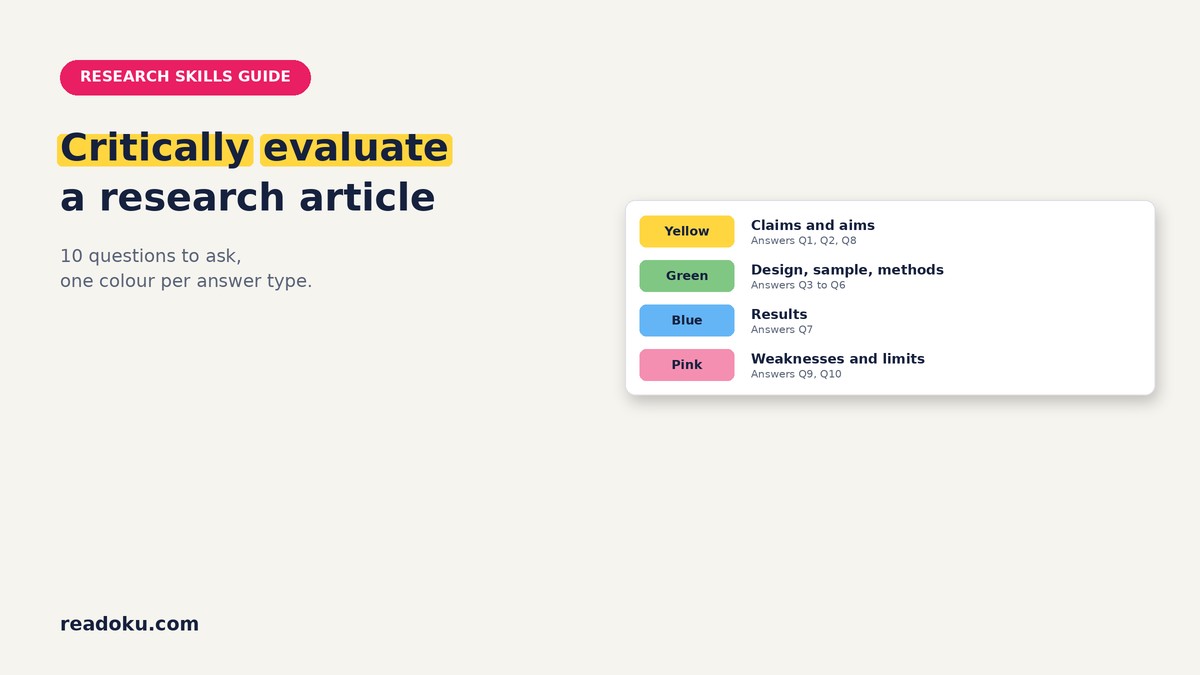
- Pick a colour for claims, methods, results and weaknesses.
- Read with the 10 questions below next to you.
- Highlight the passage that answers each question.
- Add a short comment with your judgement.
- Export your highlights and turn them into your written critique.
Why ask questions while you read?
Reading with "why" and "how do they know?" questions keeps you active. Asking such questions, known as elaborative interrogation, was rated as a technique of moderate usefulness in a large review of study methods (Dunlosky et al., 2013). A classic guide to reading papers also starts with simple questions: why was the study done, and what kind of study is it (Greenhalgh, 1997).
Which 10 questions should you ask?
- What question does the study ask? Find the aim in one sentence.
- Why does it matter? What gap or problem does it address?
- What type of study is it? Experiment, survey, interviews, review?
- Does the design fit the question? Could this design really answer it?
- Who or what was studied? Check sample size and how participants were chosen.
- How was it measured? Are the tools and measures clearly described?
- What are the main results? Note the key numbers or themes.
- Do the conclusions follow from the results? Watch for claims that go further than the data.
- What are the limitations? Look at what the authors admit and what they leave out.
- Who funded it, and does it apply to your context? Check funding and conflicts of interest, and whether the setting matches yours.
For formal checklists by study type, see the free CASP checklists.
How do you mark the answers in the PDF?
Use one colour per kind of answer. For example:
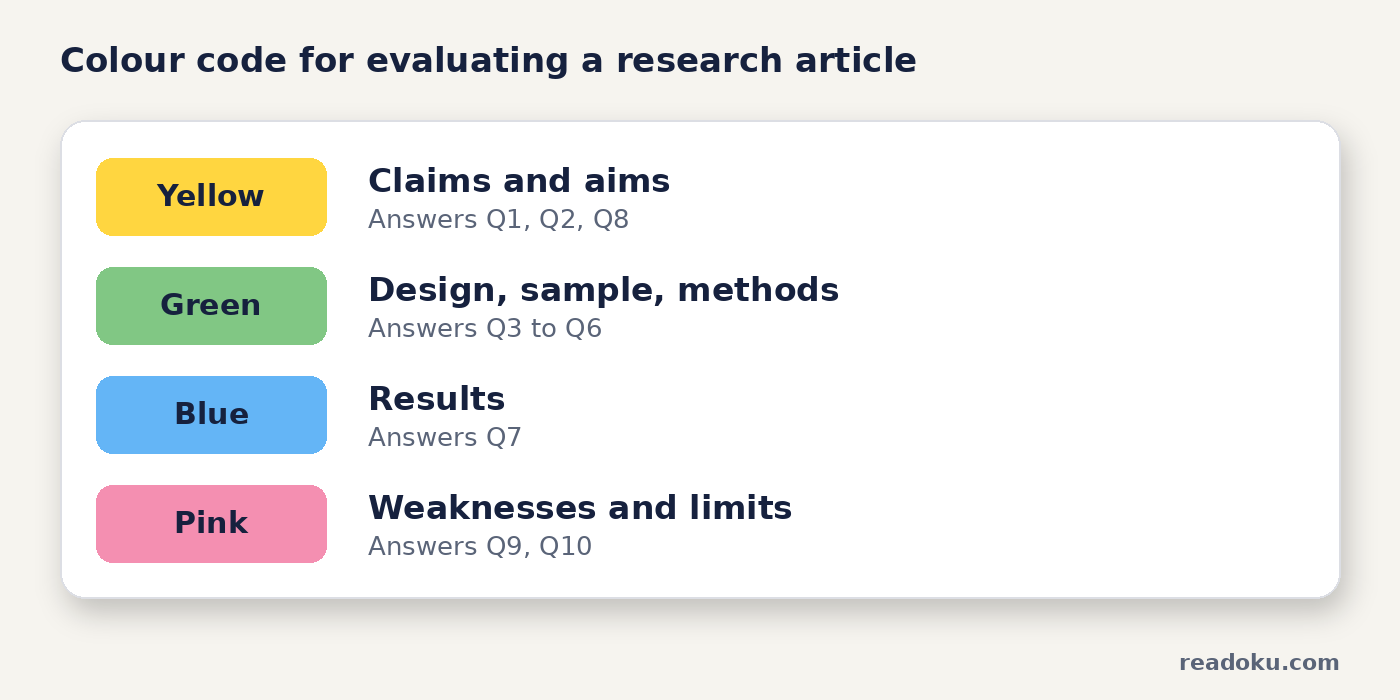
- Highlight the answer passage. One highlight per question is enough.
- Add a short comment. Write the question number and your verdict, for example "Q5: small sample, only one university".
- Mark weaknesses in pink. These become the core of your critique.
Want a full colour system? See the 4-color PDF highlighting system for research papers.
How do you turn your highlights into a written critique?
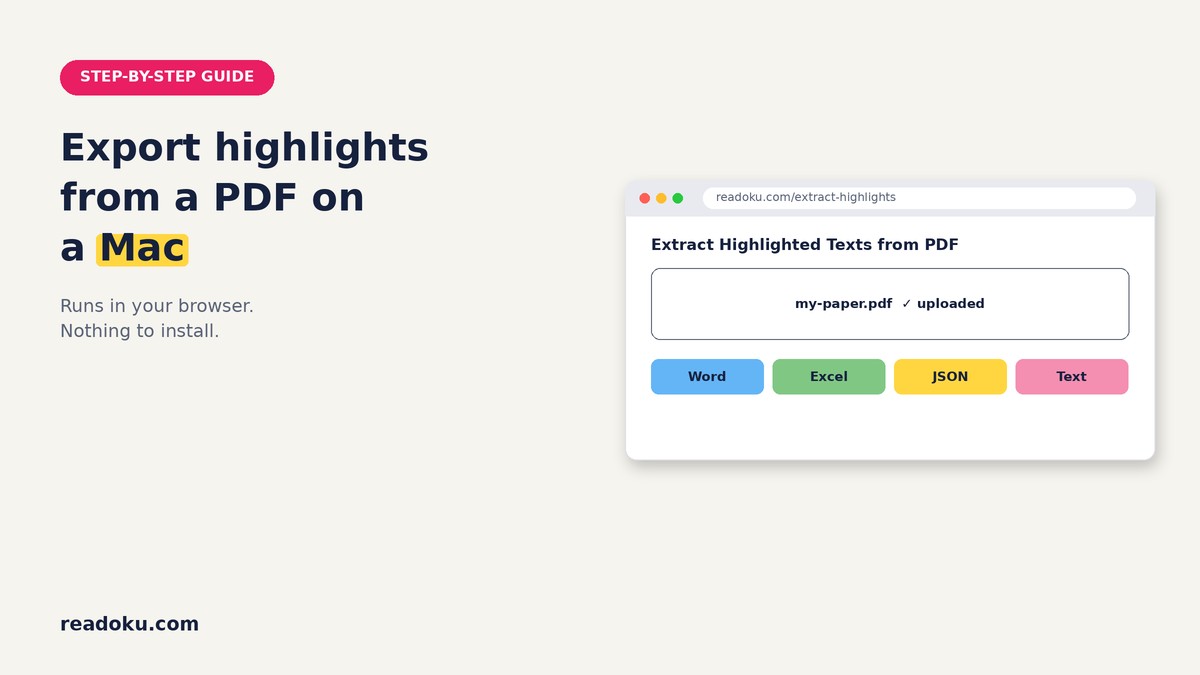
- Upload the PDF at readoku.com/extract-highlights.
- Filter by colour. Export pink first: that is your list of weaknesses, with page numbers and comments.
- Export to Word. Each passage keeps its page heading, so quoting is easy.
- Write one paragraph per question group: aim and design, sample and methods, results and conclusions, limitations.
Subscribers can add citation details to a file and get an APA reference in the export.
Common mistakes
- Summarising the paper instead of judging it
- Only listing weaknesses, without saying what the study does well
- Accepting the abstract's claims without checking the results
- Forgetting page numbers for direct quotes
For more ways to read papers actively, see smart reading tricks.
Good to know
- Sign-in required to upload. Free accounts get 3 uploads in total. There is no free trial.
- Exports: Word, Excel, JSON, Text and copy to clipboard. Comments attached to highlights are included.
- Price: EUR 2/month or EUR 12/year (EUR 1/month, 50% off), with a 14-day refund.
FAQ
How long should a critical evaluation take?
For a typical journal article, plan one focused reading with the questions, then a second pass to check your notes.
Do I need to answer all 10 questions?
Not always. Pick the questions that matter for your assignment or journal club, but always check design, sample and limitations.
What is the difference between a summary and a critique?
A summary says what the paper found. A critique says how much you can trust it, and why.
Can I use this for a literature review?
Yes. Your pink and blue highlights from each paper feed straight into a literature review matrix.
Start with your next paper
Read one article with the 10 questions, then export your colour-coded notes. Reviewing many papers? The EUR 12/year plan takes you past the 3 free uploads.