A spaced repetition study schedule tells you exactly when to review each topic before your exam, so you stop cramming the night before. Here is how to build one in about 20 minutes.
Quick answer
- Write down your exam date and list your topics.
- Study each topic once, then plan 3 to 4 reviews.
- Space the reviews further apart as the exam gets further away.
- Put every review into your calendar with a date.
- Start each review by testing yourself, not by rereading.
Why does spacing your reviews work?
Studying the same material in several spread-out sessions beats one long session. A large review of hundreds of experiments found this again and again (Cepeda et al., 2006).
The best gap also depends on how far away the test is. In a study with more than 1,350 people, the ideal gap grew as the test moved further out. Measured as a share of the time until the test, it fell from about 20 to 40% for a test one week away to about 5 to 10% for a test one year away (Cepeda et al., 2008).
How far apart should your reviews be?
Use this as a rough guide, not a strict formula:
- Exam in 1 week: review every 1 to 2 days
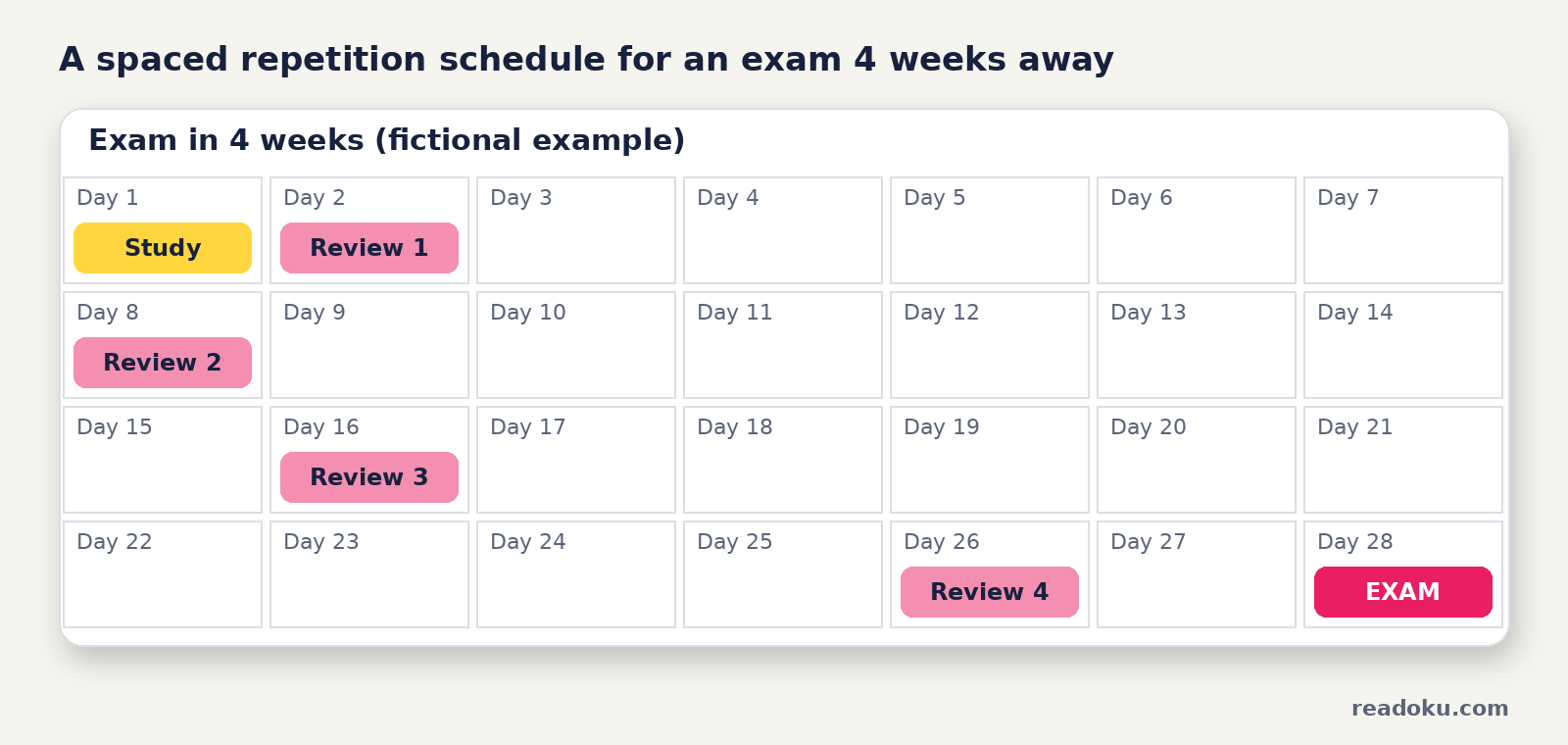
- Exam in 1 month: review about once a week
- Exam in 3 months: review about every 2 weeks
- Exam in a year: review every 3 to 4 weeks
How do you build your schedule, step by step?
- Count the days. Write your exam date at the top of a page and count the days from today.
- List your topics. One line per lecture, chapter or reading.
- Plan the first study session. Give each topic a date for the first proper study session.
- Add 3 to 4 reviews. Use the gap from the table. Make the last review 1 to 3 days before the exam.
- Put it in your calendar. Every review gets a date and a 20 to 30 minute slot.
- Keep the review list short. Each review should start from a one-page list of key points, not the full PDF.
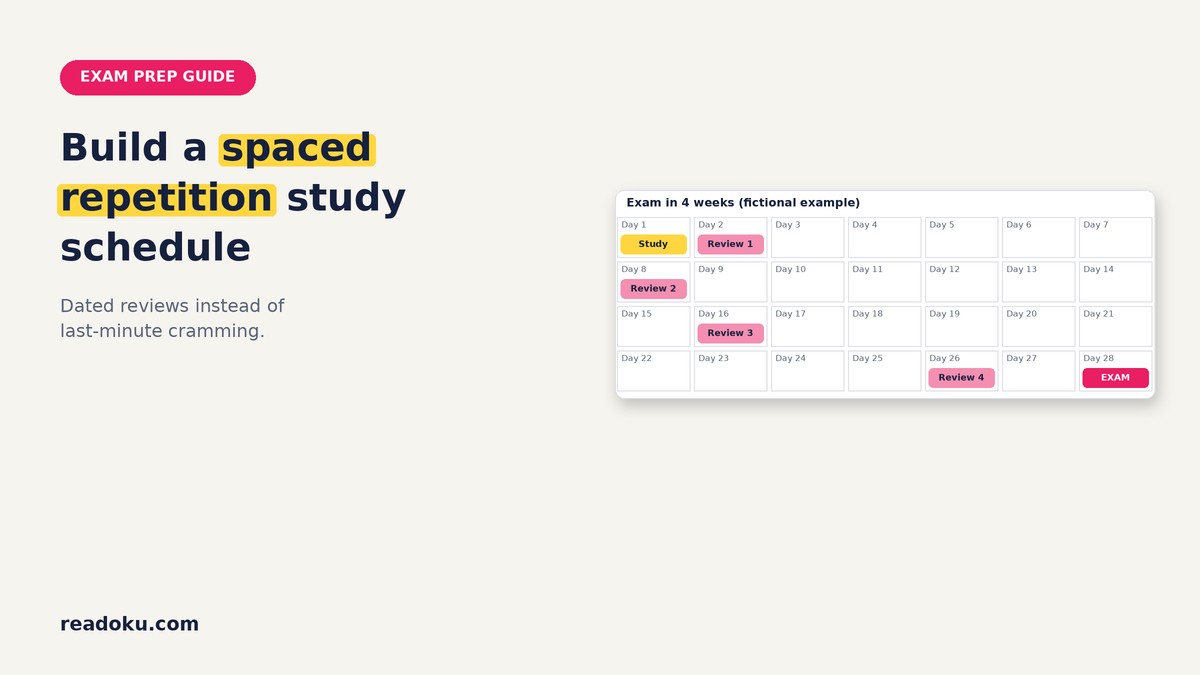
Here is a fictional example for an exam 4 weeks away:
Where does your review list come from?
Your highlights. You already marked what matters in your lecture slides and readings. Turn them into a short list:
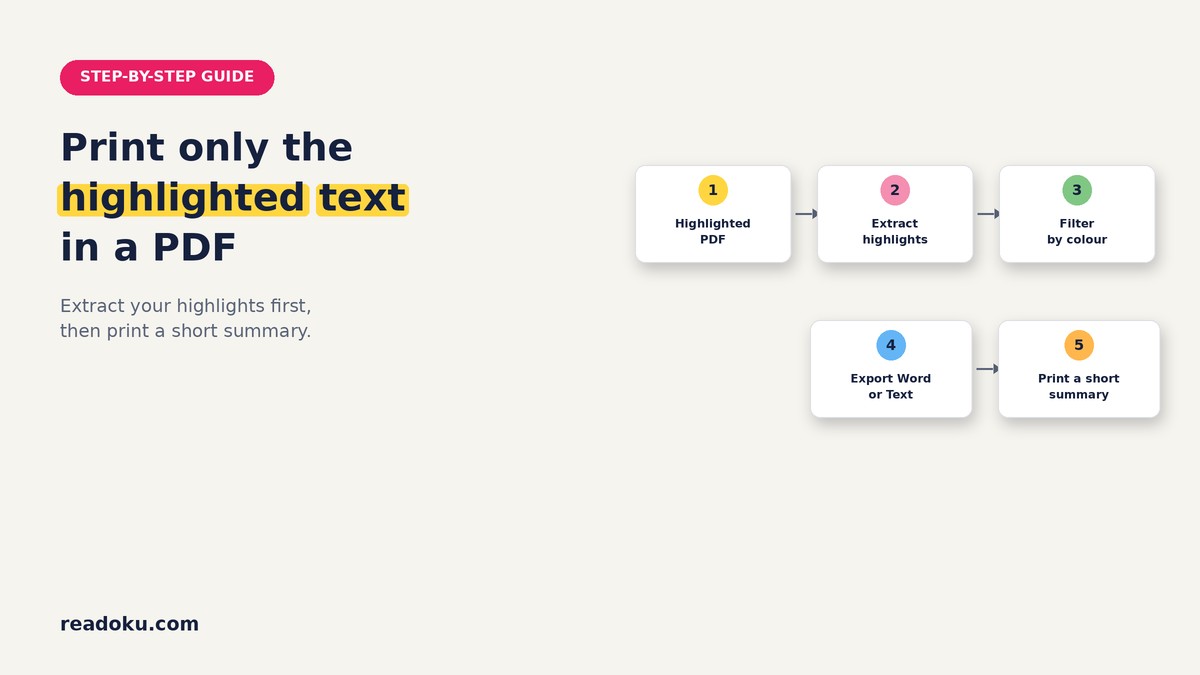
- Upload this week's highlighted PDFs at readoku.com/extract-highlights.
- Filter by colour, for example only definitions or key claims.
- Export to Text or Word and save it with the topic name and review dates.
Now every review session starts from one clean page.
What should you do in each review session?
- Test yourself first. Cover the list and write down what you remember.
- Check and mark gaps. Look at the list and mark what you missed.
- Turn highlights into questions. "What is X?" works better than reading X again. See active-recall study notes from textbook PDF highlights.
- Stop on time. Short, focused sessions are easier to keep up. Tips for focus: how to increase concentration while reading.
Common mistakes
- Rereading instead of testing yourself
- Reviewing everything every day (that is cramming, spread out)
- Skipping the dates and "reviewing when there is time"
- Starting so late that there is no room for gaps
Good to know
- Sign-in required to upload. Free accounts get 3 uploads in total. There is no free trial.
- Exports: Word, Excel, JSON, Text and copy to clipboard.
- Price: EUR 2/month or EUR 12/year (EUR 1/month, 50% off), with a 14-day refund.
FAQ
How many reviews do I need per topic?
Three to four spaced reviews per topic is a practical start. Add one more for topics you keep getting wrong.
What if my exam is only a week away?
Use short gaps of 1 to 2 days. Spacing still helps, even over a few days.
Can I use spaced repetition for essay exams?
Yes. Review your key arguments and evidence the same way, then practise writing outlines from memory.
Should I review all subjects on the same day?
Mixing two or three subjects per day is fine. Just keep each review short.
Start this week
Upload this week's lecture PDFs and turn your highlights into your first review list. A full semester of readings? The EUR 12/year plan takes you past the 3 free uploads.