If deep reading feels so hard lately, you are not broken. You open a chapter, read two lines, and your hand is already reaching for your phone. Then comes the guilt. This guide shows you how to get your focus back in short, kind steps.
Quick answer
- Accept that focus is a skill you can retrain, not a fixed trait.
- Put your phone in another room for one session.
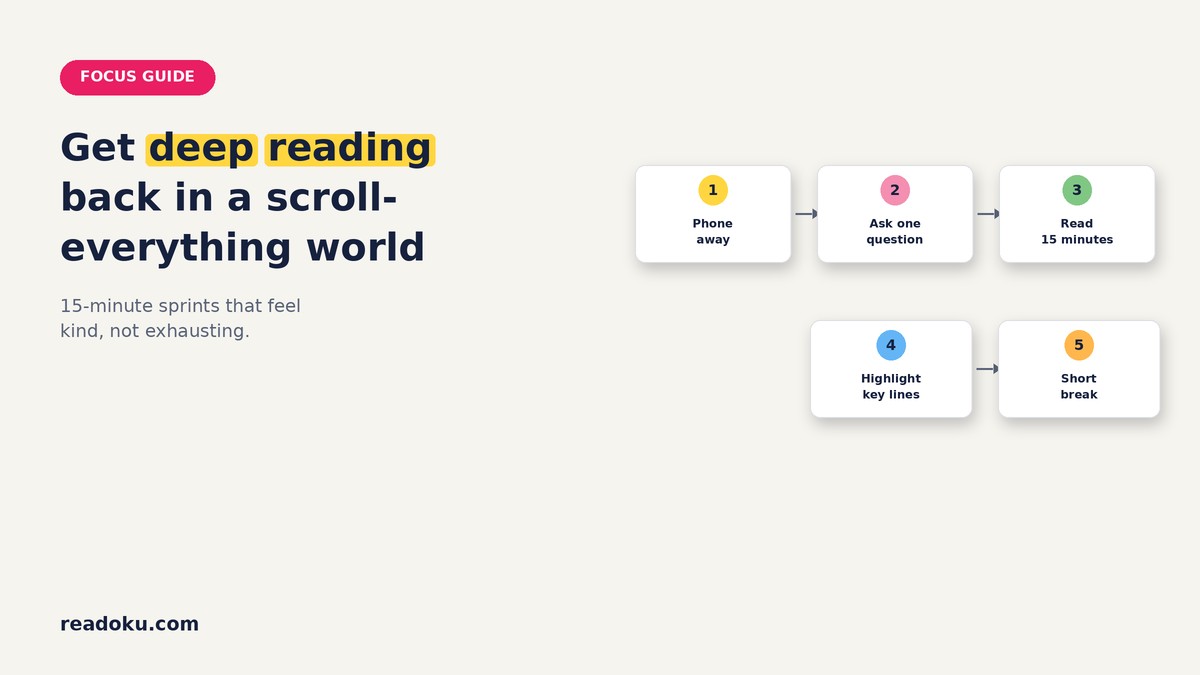
- Read in 15-minute sprints with one clear question.
- Highlight as you read, so nothing feels lost.
- Stop after the sprint, take a short break, and decide on the next one.
Why does deep reading feel so hard now?
Most of our day is fast: short clips, quick replies, endless feeds. Your brain gets used to skimming, then skimming follows you into your textbook.
Research backs this up in a gentle way. A large meta-analysis of 54 studies found that people understood texts a little better on paper than on screens, and that the gap grew when readers were under time pressure (Delgado et al., 2018). The lesson is not "screens are bad". It is that rushing makes reading shallow, wherever you read.
So the fix is not more willpower. It is a slower, clearer setup.
Is it your fault you can't focus?
No. Attention guilt is very common among students and readers. Telling yourself "I'm lazy" only adds stress, and stress makes reading even harder.
Try a kinder sentence instead: "My attention is out of practice. I'll train it a little each day." That small shift turns a failure into a plan.
How do 15-minute reading sprints work?
A sprint is a short, protected block of reading with a clear finish line. Fifteen minutes is long enough to get into a text and short enough to feel safe.
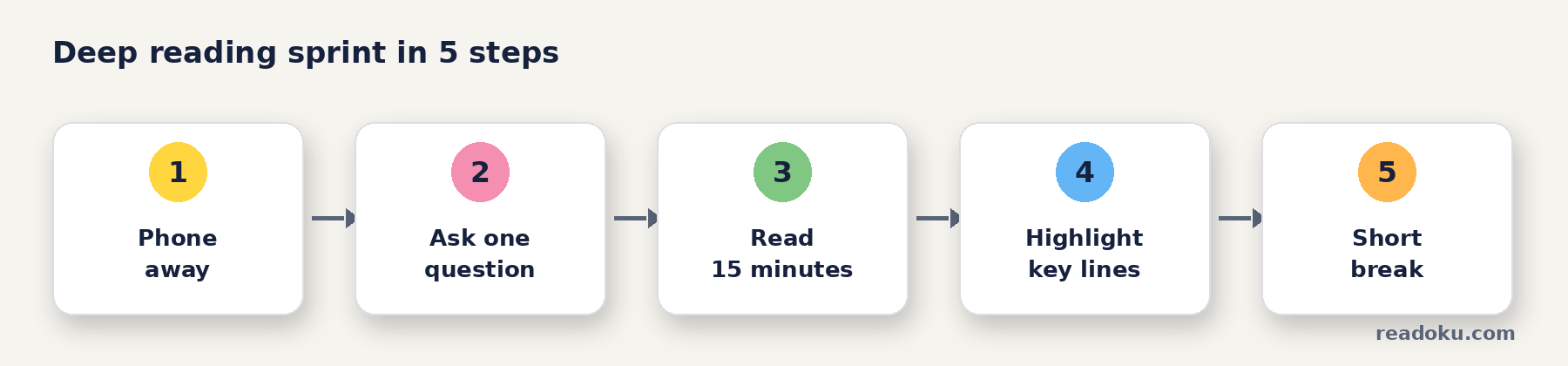
- Clear the space. Phone in another room, notifications off, one tab open.
- Ask one question. For example: "What is the main argument of this chapter?"
- Set a timer for 15 minutes. Read only that text until it rings.
- Highlight as you go. Mark the lines that answer your question. One or two per page is enough.
- Take a 5-minute break. Stand up, drink water, look out of a window. Then choose: one more sprint, or done for now.
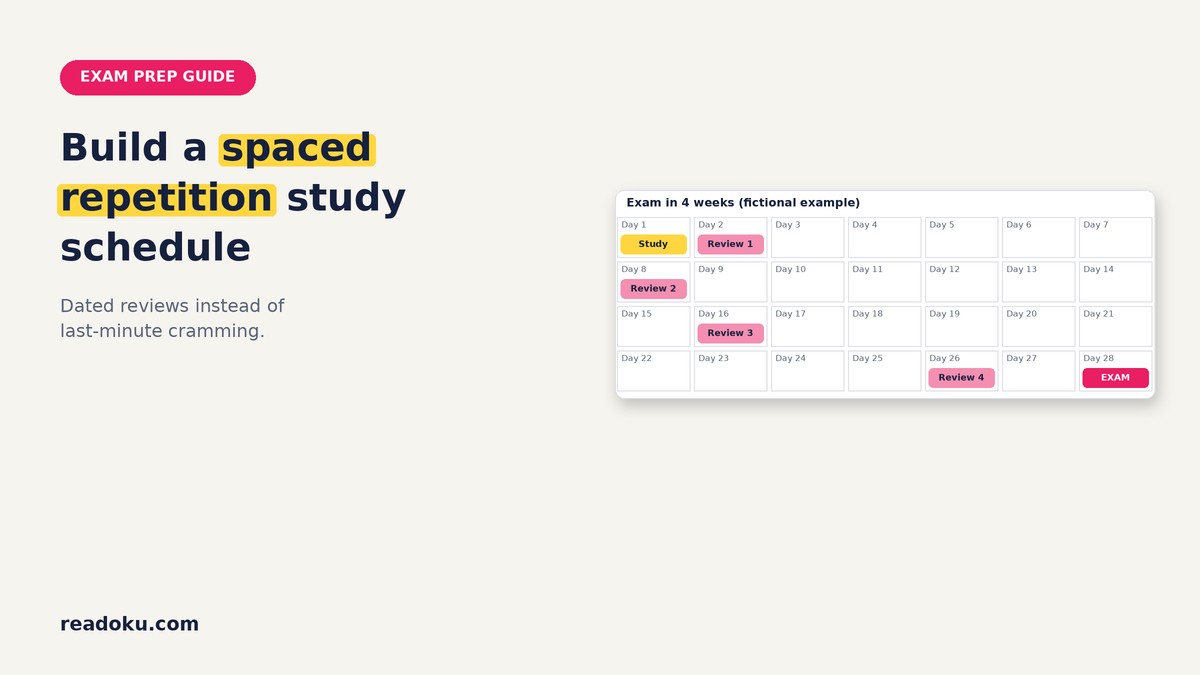
Start with one sprint a day. When it feels easy, add a second. Small, steady wins beat a heroic Sunday that leaves you exhausted.
What if your mind keeps wandering?
It will, and that's normal. Each time you notice it, you're training your attention.
- Keep a "later" note. Write down the stray thought ("reply to Sam") and return to the page.
- Read one paragraph aloud if you lose the thread twice in a row.
- Lower the bar. If 15 minutes feels too long, try 10. Progress counts more than the number.
For more ideas, see how to increase concentration while reading.
Why highlight as you read?
Part of the stress of deep reading is fear: "If I slow down, I'll forget everything anyway." Highlighting gives your reading a visible trace. You know the important lines are saved, so you can relax into the text.
Keep it simple:
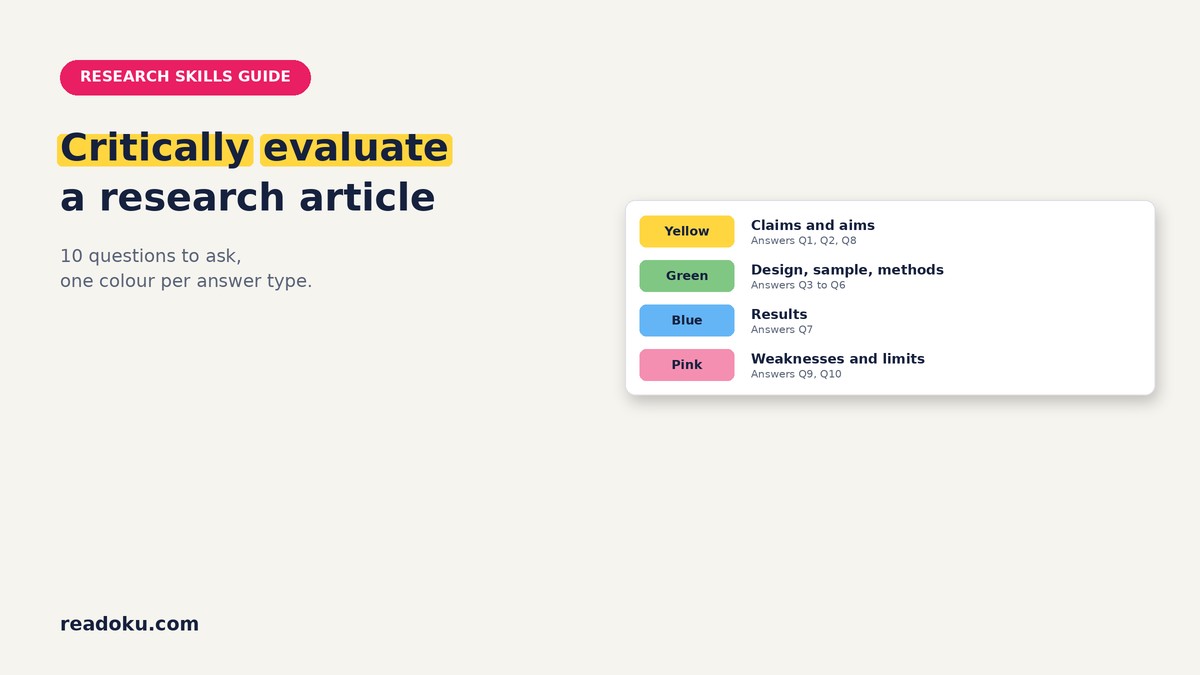
- Yellow for main ideas
- Pink for things you want to question or remember
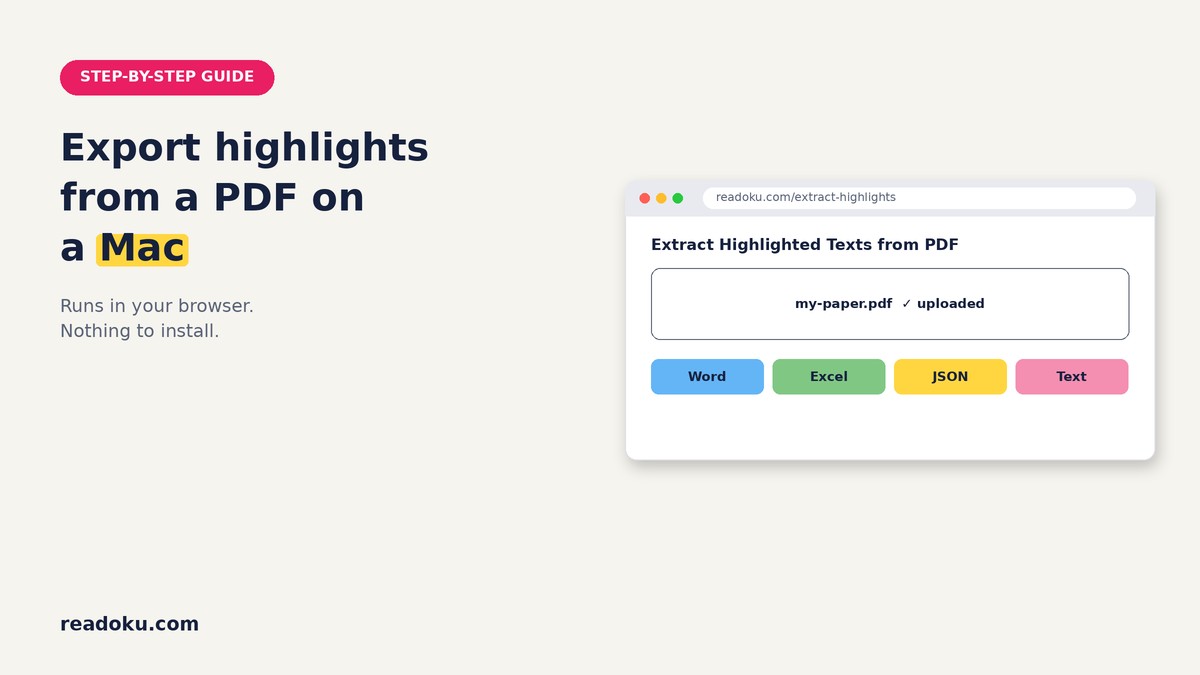
Then extract everything later instead of flipping back through pages. Upload your highlighted PDF at readoku.com/extract-highlights and download your highlights with page numbers as Word, Excel, JSON or Text, or copy them to your clipboard. Comments you added to highlights come along too.
Not sure what to mark? Read why most people highlight wrong.
How do you turn sprints into a habit?
- Same time, same place. For example, right after breakfast at your desk.
- Track sprints, not pages. A tick for each finished sprint is enough.
- Review your highlights weekly. Seeing a growing list of saved ideas is proof that your focus is coming back.
Good to know
- Sign-in required to upload. Free accounts get 3 uploads in total. There is no free trial.
- Scanned PDFs: OCR finds yellow and pink highlights. Free accounts can OCR PDFs up to 15 pages; subscribers have no page limit.
- Price: EUR 2/month or EUR 12/year (EUR 1/month, 50% off), with a 14-day refund.
FAQ
How long does it take to get focus back?
It is different for everyone. Most people notice that sprints feel easier after a few days of practice. Be patient with yourself.
Is 15 minutes really enough?
Yes, to start. A short sprint you actually do is worth more than a two-hour plan you avoid.
Should I read on paper or on screen?
Either can work. What matters most is reading slowly, with a question and without distractions.
What if I still feel stressed when I read?
Keep sessions short and gentle. If stress stays high for a long time, talk to someone you trust or your university's counselling service.
Start your first sprint today
Pick one PDF, set a 15-minute timer and highlight the lines that matter. When you finish, extract them in seconds and see what you saved.