You used to love reading. Now even opening a book or a PDF feels heavy. If you want to love reading again after burnout, the answer is not to force it. It's to restart gently, with small wins that remind you why you started.
Quick answer
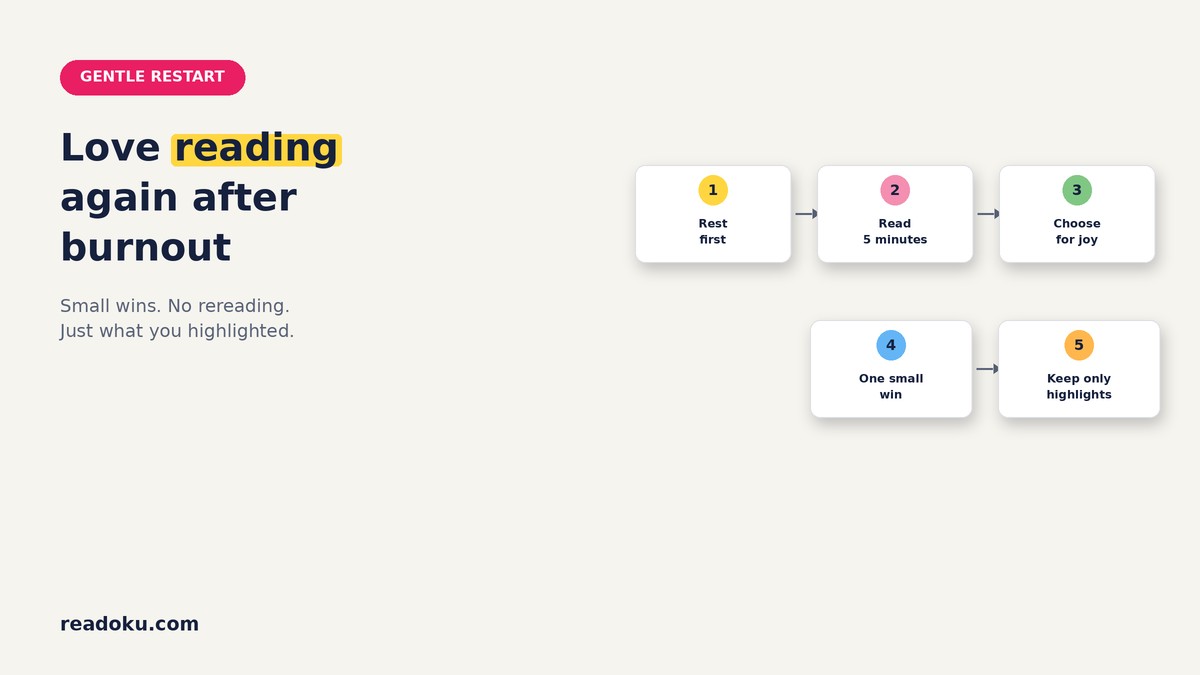
- Rest first. Don't fight the tiredness.
- Restart with very small reading moments, five to ten minutes.
- Read something you choose, not only what you must.
- Collect small wins: one highlight, one idea, one page.
- Skip rereading. Keep only what you highlighted.
What does reading burnout feel like?
- Words blur and nothing sticks.
- You feel guilty about every unread page.
- Reading feels like a duty, never a joy.
- You avoid books, then feel worse for avoiding them.
The World Health Organization describes burnout as an occupational phenomenon linked to chronic workplace stress that hasn't been managed well. It is not classed as a medical condition (WHO, 2019). For students and researchers, study is often that workplace.
This guide shares general study and wellbeing tips. If you feel exhausted most days, or it affects your sleep, mood or health, please speak to a doctor or your university's counselling service.
Why does forcing yourself to read make it worse?
When reading only ever means pressure, your brain links books with stress. Pushing harder adds more pressure.
Motivation research suggests that people stay more engaged when they feel a sense of choice and competence in what they do (Ryan and Deci, 2000). So the way back is more choice and more small successes, not more force.
How do you restart reading gently?
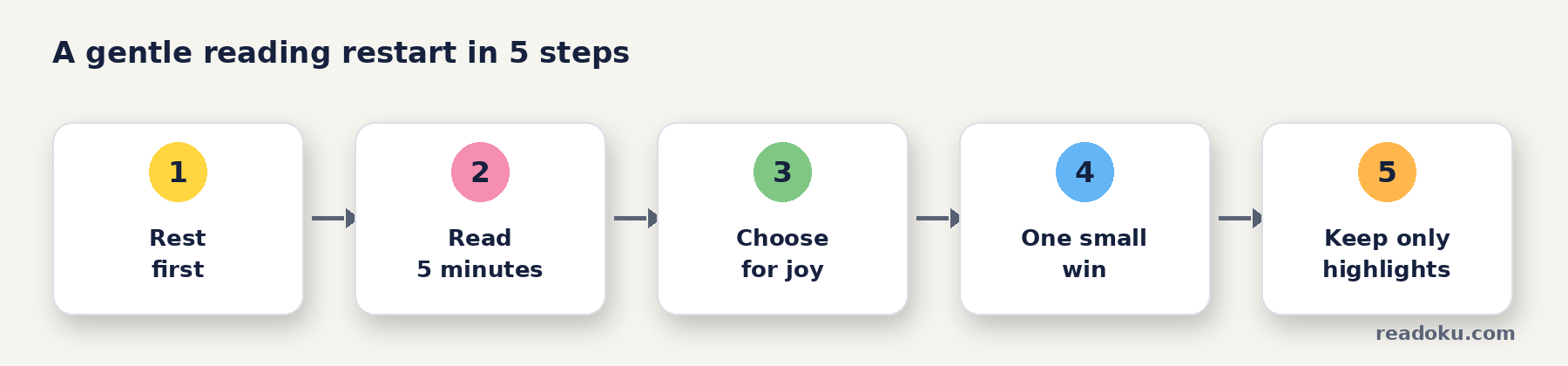
- Take a real break. A few days with no "should read" can reset the pressure. Walk, sleep, see friends.
- Start tiny. Five to ten minutes. Stop while it still feels okay.
- Choose for joy. An essay, a short story, an old favourite. Something with no grade attached.
- Set one small win per session. "Find one line I like." That's it.
- Make a simple plan. Decide when and where: "After dinner, on the sofa, ten minutes." Plans like this, called implementation intentions, help people follow through on goals (Gollwitzer and Sheeran, 2006).
How do small wins rebuild your love for reading?
Each small win tells your brain: "Reading can feel good again."
- Highlight one line that makes you think or smile.
- Add a comment: why did you like it?
- Notice the feeling after a session, even if it's only "that was fine".
After a week or two, you'll have a small collection of lines you chose. That collection is evidence that reading is becoming yours again.
For more gentle ideas, read healthy reading tips.
How do you get back to study reading without rereading everything?
Burnout often comes with a fear: "I've forgotten everything, I'll have to start again." You probably don't.
- Open the PDFs you already highlighted. Your past self did a lot of work.
- Upload them at readoku.com/extract-highlights.
- Extract only what you highlighted, with page numbers and comments, as Word, Excel, JSON or Text.
- Read your highlights, not the whole text. Five pages of notes instead of fifty pages of PDF.
- Return to the full text only where a highlight needs more context.
This turns a mountain of rereading into a short, manageable review.
What should you avoid while recovering?
- Big reading targets ("a book a week")
- Comparing your pace with others
- Reading late at night when you're exhausted
- Treating one bad day as a sign of failure
Good to know
- Sign-in required to upload. Free accounts get 3 uploads in total. There is no free trial.
- Scanned PDFs: OCR finds yellow and pink highlights. Free accounts can OCR PDFs up to 15 pages; subscribers have no page limit.
- Price: EUR 2/month or EUR 12/year (EUR 1/month, 50% off), with a 14-day refund.
FAQ
How long does it take to enjoy reading again?
It varies. Many people notice small changes after a couple of weeks of gentle, regular reading. Go at your own pace.
Should I stop reading completely for a while?
A short break can help. Then return with tiny, enjoyable sessions rather than waiting to feel fully ready.
What if my studies don't allow a break?
Keep the required reading short and focused, and use your existing highlights to avoid rereading.
Is it normal to lose interest in reading?
Yes. Interest often comes and goes, especially in stressful periods. It can come back.
Take your first small step
Pick one text you already highlighted. Extract those highlights and read only them tonight, ten minutes, nothing more.