You read a whole page, reach the bottom and realise you remember nothing. Then the panic starts: "What's wrong with me? The exam is in two weeks." If reading anxiety sounds familiar, take a breath. Forgetting is normal, and there is a calm, simple way to make reading stick.
Quick answer
- Stop rereading the same page. It feels safe but rarely helps much.
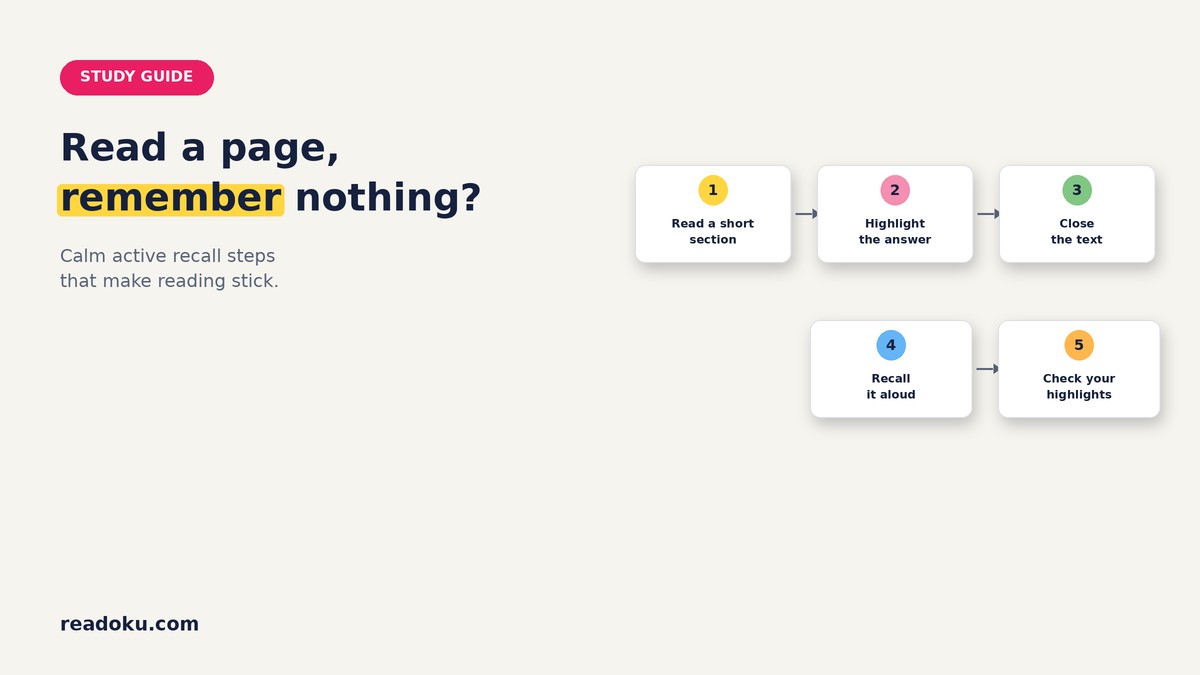
- Read one short section with a question in mind.
- Highlight only the answer to that question.
- Close the text and say or write what you remember.
- Turn your highlights into recall questions and review them later.
Why do you remember nothing after reading a page?
Usually it's not your memory. It's how you read.
- Your eyes moved, but your mind was elsewhere. Stress and worry pull attention away from the page.
- You read passively. Nothing asked your brain to use the information.
- Forgetting is natural. A modern replication of the classic forgetting curve showed that we lose much of new material quickly unless we review it (Murre and Dros, 2015).
So "I remember nothing" doesn't mean "I can't learn". It means you need a different method.
Is rereading the answer?
Rereading feels productive because the text looks familiar. But familiar is not the same as remembered.
In a well-known experiment, students who practised recalling a text remembered more a week later than students who simply studied it again (Roediger and Karpicke, 2006). This is called active recall or retrieval practice.
There's a calming bonus. In a study with school students, most said that regular retrieval practice made them feel less nervous about tests (Agarwal et al., 2014).
How do you use active recall while reading?
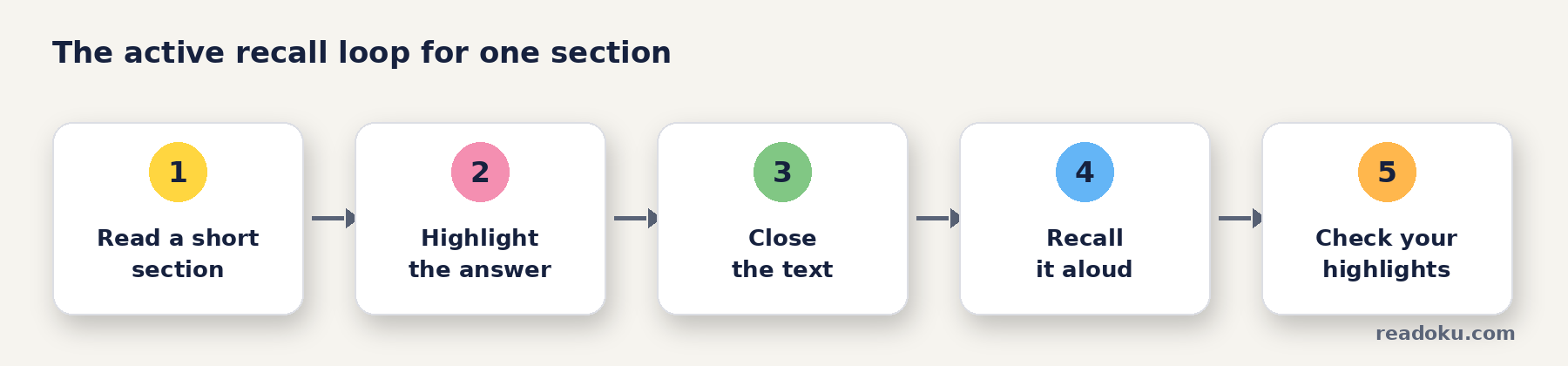
- Pick a small section. One page or one subheading. Not a whole chapter.
- Ask a question first. Turn the heading into a question: "What causes inflation?"
- Read and highlight the answer. Use yellow for key ideas, pink for definitions.
- Close the PDF. Say or write the answer in your own words. It's fine if it's messy.
- Check your highlights. What did you miss? Add a short comment to that highlight.
- Repeat for the next section.
This feels harder than rereading. That effort is a sign that learning is happening, not that you're failing.
How do you calm down when reading anxiety hits?
- Breathe slowly for a minute before you start.
- Shrink the task. "Read one section" is easier than "learn chapter 5".
- Write the worry down on paper, then put it aside until your break.
- Remember the goal: understanding, not perfection.
If anxiety stays strong for weeks or affects your daily life, please talk to a doctor or your university's counselling service.
How do you turn highlights into recall notes?
Your highlights are already the answers. Now you just need the questions.
- Extract your highlights. Upload the PDF at readoku.com/extract-highlights and download them as Word or Excel, with page numbers and comments.
- Write one question per highlight. In Excel, add a column next to the text. In Word, write the question above it.
- Hide the answers and test yourself. Cover the highlight column and answer aloud.
- Review again in a few days. Spacing reviews out helps memories last.
For a step-by-step version, see how to turn textbook PDF highlights into active recall study notes. To plan your reviews, use a spaced repetition study schedule.
Good to know
- Sign-in required to upload. Free accounts get 3 uploads in total. There is no free trial.
- Scanned PDFs: OCR finds yellow and pink highlights. Free accounts can OCR PDFs up to 15 pages; subscribers have no page limit.
- Price: EUR 2/month or EUR 12/year (EUR 1/month, 50% off), with a 14-day refund.
FAQ
Why do I forget what I read straight away?
Often because attention drifted or the reading was passive. Short sections, a question and quick recall make a big difference.
How many times should I review?
There's no magic number. Review a few times with growing gaps, for example after one day, a few days and a week.
Is it okay to look at my notes during recall?
Try first without them, then check. The trying is what strengthens memory.
Can active recall help with exam stress?
Many students find it does, because they know what they can answer before the exam.
Make your next page stick
Choose one section, highlight the answer to one question and recall it with the PDF closed. Then extract your highlights and build your first recall sheet.