What is a systematic literature review (SLR) ?
A systematic literature review (SLR) is a rigorous and transparent method for identifying, evaluating, and synthesizing existing research on a specific topic. While the methodology of SLRs is well established, researchers often struggle with the practical side of the process: reading dozens of PDFs, managing annotations, tracking evidence, and synthesizing findings without losing structure.
This guide shows how to conduct a systematic literature review using the Readoku Reader, step by step—from your first research question to final synthesis—while keeping your workflow organized, traceable, and efficient.
Step 1: Define Your Research Question
Every SLR starts with a clear and focused research question. This question determines:
- Which studies you will include
- What data you need to extract
- How you will synthesize findings
Example (Social Science):
How does remote work affect job satisfaction and well-being?
At this stage, no tool is needed yet—but clarity here will save hours later.
Step 2: Develop Your Review Protocol
Before collecting studies, define your review protocol, including:
- Databases to search
- Keywords and search strings
- Inclusion and exclusion criteria
- Time period and language restrictions
This protocol ensures transparency and prevents bias.
Tip: Save your protocol separately so you can later report it clearly in your methods section.
Step 3: Search Databases and Collect PDFs
Next, search academic databases such as:
- Scopus
- Web of Science
- PubMed
- PsycINFO
- Sociological Abstracts
You will likely end up with dozens or hundreds of PDF articles.
Using the Readoku Reader
Instead of organizing PDFs across folders and devices:
- Upload all articles into the Readoku Reader
- Keep your entire review corpus in one workspace
- Access papers anytime without re-downloading or reopening files
This becomes your central reading environment for the entire SLR.
Step 4: Screen Studies Inside the PDFs
Screening typically happens in three phases:
- Title screening
- Abstract screening
- Full-text screening
During full-text screening, researchers often jump back and forth between papers to check relevance.
Using the Readoku Reader
- Quickly navigate full texts
- Highlight inclusion-relevant passages
- Add short comments (e.g. “excluded: wrong population”)
- Keep screening decisions close to the text itself
This reduces confusion and improves traceability later.
Step 5: Read and Annotate Systematically
This is where most SLRs become overwhelming.
You are expected to:
- Read each study carefully
- Identify key concepts, methods, and findings
- Ensure consistency across dozens of papers
Using the Readoku Reader
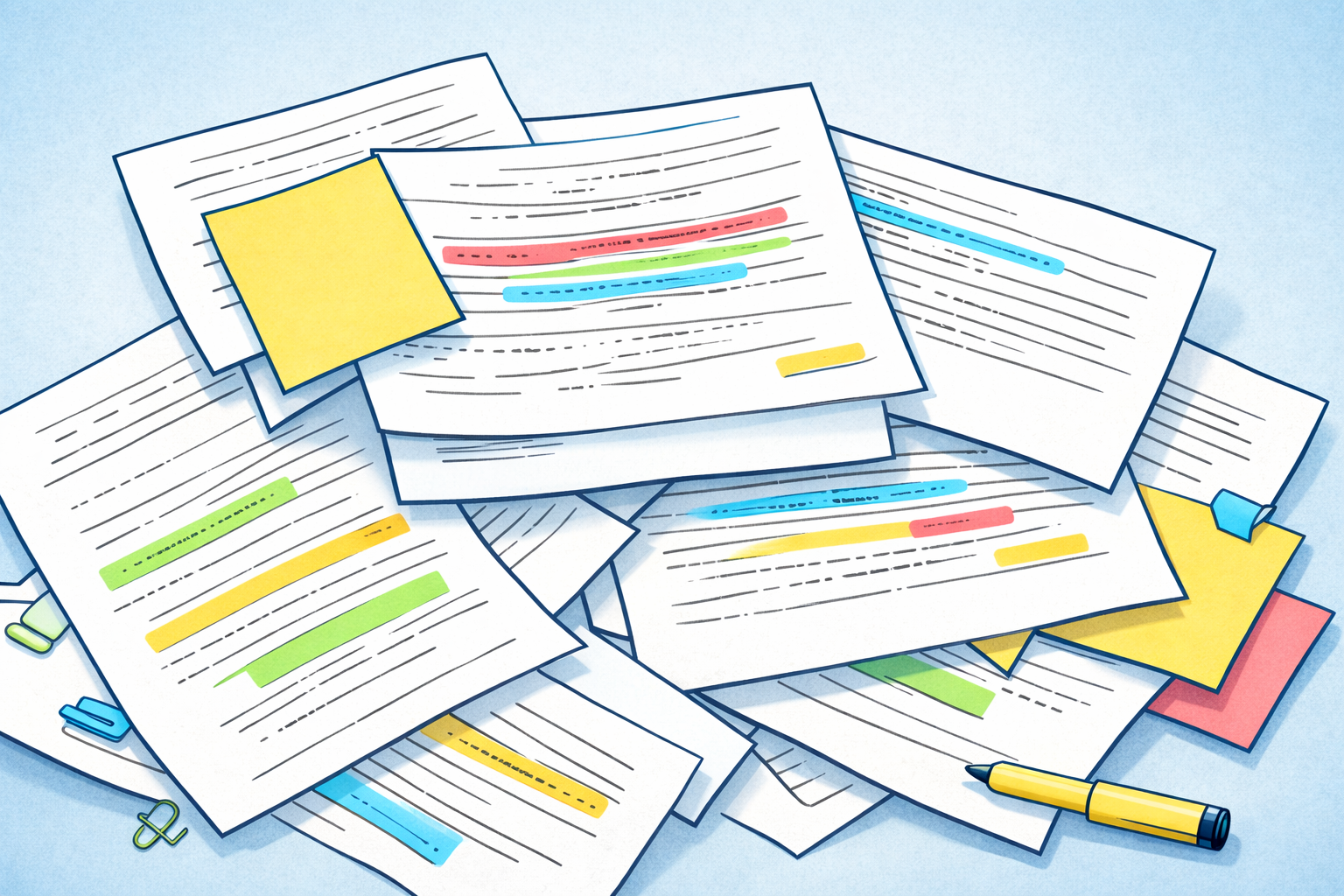
Adopt a color-coded annotation strategy, for example:
- Yellow → theory or concepts
- Blue → methods
- Green → key findings
- Red → limitations
With the Readoku Reader, you can:
- Highlight text directly in PDFs
- Add comments and notes next to key passages
- Keep annotations consistent across all papers
This turns reading into structured data collection, not passive highlighting.
Step 6: Extract Data from Annotations
Data extraction is often the most time-consuming SLR step.
Traditionally, this involves:
- Reopening PDFs
- Copy-pasting highlights into spreadsheets
- Manually checking sources
Using the Readoku Reader
With one click, you can:
- Extract all highlights with their comments
- Organize them by color, page number, or annotation type
- Export them into Word, Excel, JSON, or plain text
This creates a clean, structured dataset directly from your reading.
Step 7: Synthesize the Literature
Synthesis means making sense of findings across studies, not summarizing them one by one.
Common synthesis approaches:
- Narrative synthesis (themes, patterns, contradictions)
- Comparative tables
- Meta-analysis (when data allows)
Using the Readoku Reader
Because your highlights are already structured:
- Compare findings across multiple studies easily
- Group evidence by theme or variable
- Trace every claim back to its original source
This strengthens the credibility and transparency of your review.
Step 8: Write and Report the Review
A high-quality SLR clearly reports:
- Search strategy and protocol
- Screening and selection decisions
- Key findings and research gaps
- Implications for future research or practice
With Readoku exports, you can:
- Cite directly from extracted highlights
- Reduce errors caused by manual copying
- Maintain a clear link between text and sources
Why the Readoku Reader Is Ideal for Systematic Literature Reviews
Systematic literature reviews rely on:
- Transparency
- Traceability
- Reproducibility
The Readoku Reader supports these principles by:
- Centralizing all research PDFs
- Preserving the connection between annotations and sources
- Turning highlights into exportable research material
- Eliminating repetitive and manual work
Instead of spending hours managing PDFs, researchers can focus on analysis, synthesis, and theory building.
Conclusion
Conducting a systematic literature review is demanding—but it does not have to be chaotic. By combining a rigorous SLR methodology with the Readoku Reader, researchers can transform scattered PDFs into a structured, efficient, and transparent research workflow.
If your review involves heavy reading, annotation, and synthesis, the Readoku Reader becomes more than a tool—it becomes part of your research method.
Streamline Your Literature Review Today
Extract and Organize PDF Highlights with Readoku → to synthesize findings across dozens of research papers effortlessly. Related guides: How to Build a Literature Review Matrix from PDF Highlights (Step by Step), Thesis Writing Tricks That Actually Work, and Introducing In-Text Citations in Readoku.