You highlighted half the chapter. It felt productive. Then the exam asked you to explain the idea in your own words, and the yellow lines were no help.
That gap is not about effort. It is about method. Highlighting tells you what looked important while you read; it does not train you to pull that information out of memory later. This guide shows how to turn the highlights you already have in a textbook PDF into active-recall study notes you can actually practise with.
What the Research Says About Highlighting and Recall
A large review of ten common study techniques by Dunlosky and colleagues (2013) rated highlighting and rereading as low utility, while practice testing and spacing out your study sessions were rated high utility. Highlighting is not useless, but on its own it rarely improves exam performance.
Practice testing, often called retrieval practice or active recall, works differently. In a classic experiment, Roediger and Karpicke (2006) found that students who studied a text and then practised recalling it remembered more a week later than students who simply studied it again, even though the restudy group felt more confident. Karpicke and Blunt (2011) later showed that retrieval practice produced more meaningful learning than building a concept map with the text open, including on questions that required inference.
The takeaway: your highlights are a good raw material. The learning happens when you turn them into questions and answer those questions without looking. (For more on why marking text feels better than it works, see Why Most People Highlight Wrong.)
A Concrete Example: One Biology Highlight, Three Questions
Say you highlighted this sentence on page 112 of a cell biology textbook:
"Enzymes lower the activation energy of a reaction but do not change its equilibrium."
As a highlight, it just sits there. As study material, it becomes:
- Recall: What do enzymes change about a chemical reaction, and what do they leave unchanged?
- Explain: Why does lowering activation energy speed up a reaction?
- Apply: If you add more enzyme to a reaction already at equilibrium, what happens to the ratio of products to reactants?
Each question has a short answer you can check against page 112. One passive line just became three chances to practise remembering.
The Workflow: From Textbook PDF to Active-Recall Notes
1. Highlight with a simple color code
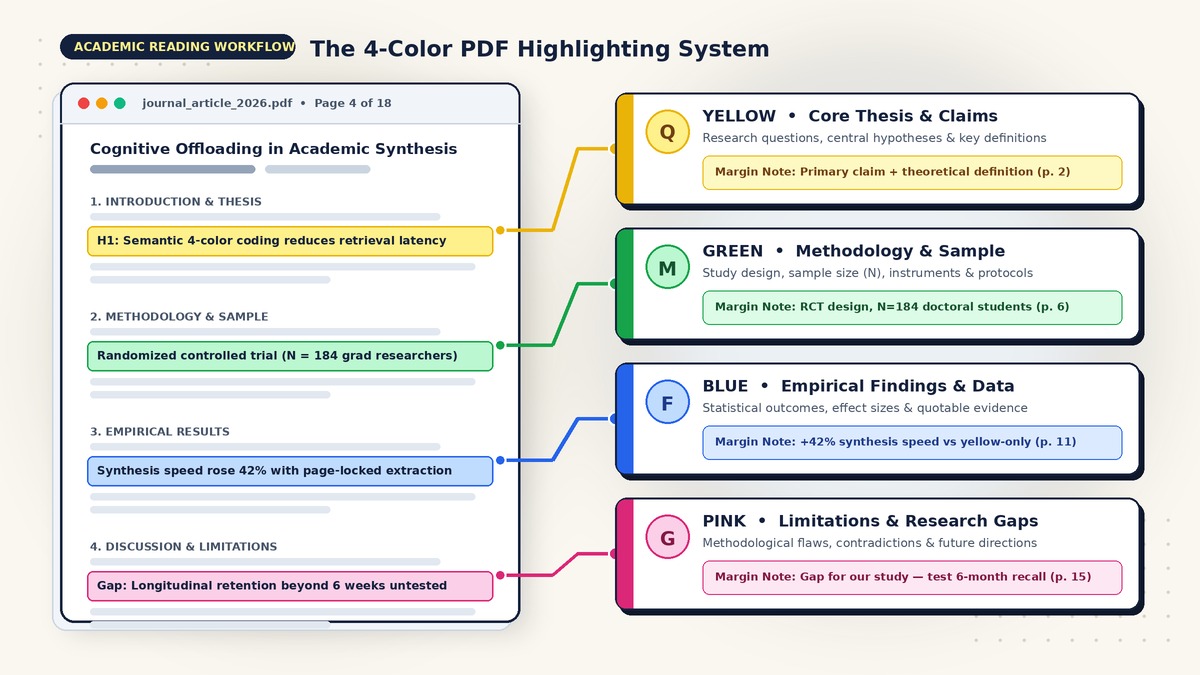
Use a small, consistent system so your future self knows what each mark means. For example: yellow for definitions, green for processes and mechanisms, pink for examples and exceptions. If you want a ready-made scheme, the 4-color highlighting system adapts well to textbooks.
2. Extract every highlight in one step
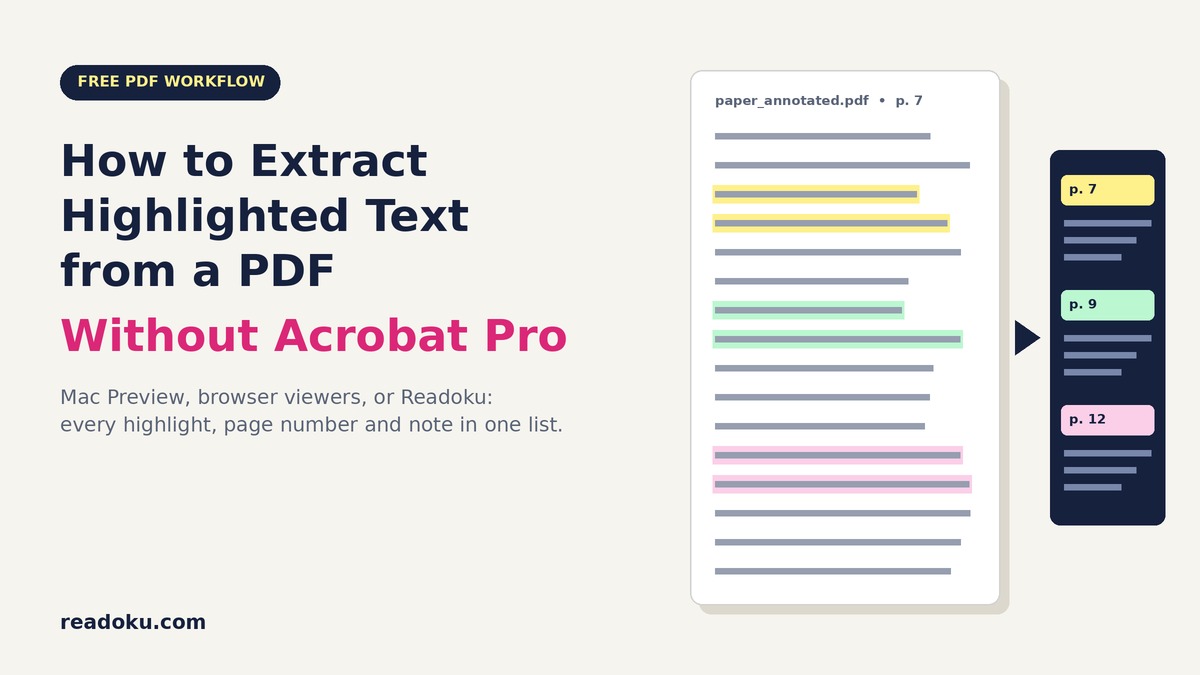
Copying highlights out of a 400-page PDF by hand is where most study plans stall. Upload the annotated chapter to Readoku's PDF Highlight Extractor and you get a clean list of highlighted text with page numbers, highlight colors, and any notes you attached. If you are unsure how extraction works, the previous post in this series, How to Extract Highlighted Text from a PDF Without Adobe Acrobat Pro, walks through it.
3. Turn each highlight into a question
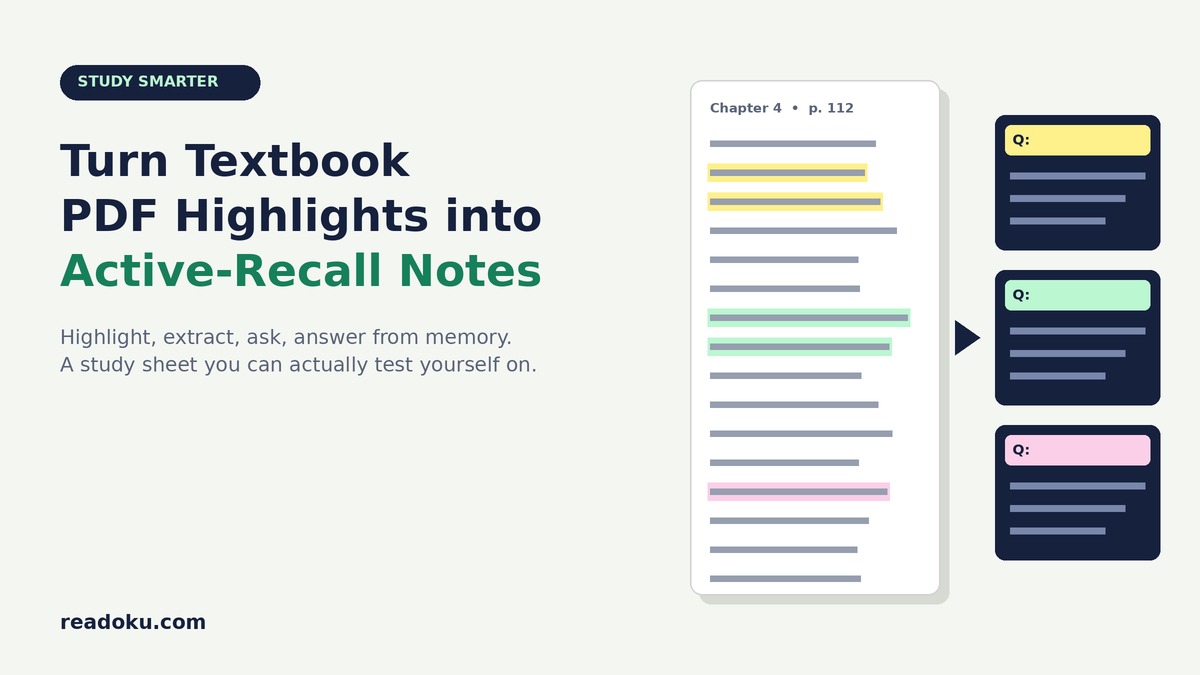
Go through the list and rewrite each highlight as a question whose answer is the highlight. Use the color to guide the question type:
- Definitions (yellow): "What is...?" or "Define..."
- Processes (green): "How does...?" or "What are the steps of...?"
- Examples (pink): "Give an example of..." or "When does this not apply?"
Keep the page number next to each question so checking answers takes seconds.
4. Build a Cornell-style study sheet
Split a page or document into two columns. Questions go on the left, short answers in your own words go on the right, and a two- or three-sentence summary of the chapter goes at the bottom. Writing the summary from memory is itself a retrieval exercise.
5. Test yourself, then check
Cover the answer column and answer each question out loud or on paper. Only then look. Mark the ones you missed; those are your priorities for the next session. Brief flashcards work too: question on one side, answer and page number on the other.
6. Space out your review
Return to the same questions after a day, then after a few days, then a week later. Spacing was the other high-utility technique in the Dunlosky review, and it pairs naturally with a question list you have already built.
Common Mistakes to Avoid
- Copying the highlight as the answer word for word. Paraphrase it; putting the idea into your own words is part of the learning.
- Writing only "What is X?" questions. Mix in "why" and "what if" questions so you practise understanding, not just recognition.
- Checking the answer too quickly. Give yourself a real attempt first, even if it is wrong. The effort of retrieval is what helps.
- Highlighting more to feel safer. Fewer, better highlights make a shorter, sharper question list.
Make It a Weekly Habit
A realistic rhythm for a semester course:
- Read and highlight the week's chapter.
- Extract the highlights and write your questions the same day.
- Do a short self-test two days later and again at the weekend.
- Before the exam, combine all weekly sheets and test yourself on the questions you missed most often.
If concentration is the bottleneck during the reading phase, these focus tips help. And if you want your notes to keep growing beyond one exam, see From PDF Highlight to Idea System.
Try it with your next chapter: upload an annotated textbook PDF to Readoku's PDF Highlight Extractor, get every highlight with its page and color in one list, and turn it into your first active-recall study sheet today.