We live in a world where collecting books feels like progress. Your shelf grows, your e-reader fills up, your PDFs keep piling up.
But research shows something different:
learning is not about how much you read, but how you process what you read.
The Real Problem: Passive Reading
Most readers consume content passively. They highlight extensively, but rarely revisit or connect ideas.
In academic research, this approach would be considered weak. A proper literature review is defined as a systematic, explicit, and reproducible process of identifying, evaluating, and synthesizing knowledge (Okoli, 2015).
Simply put:
Reading without processing is not learning.
Why More Reading Doesn’t Equal More Knowledge
Scholars emphasize that knowledge advances only when existing work is analyzed, synthesized, and connected, not just collected (Xiao & Watson, 2017).
This means:
- Reading 10 books passively ≠ understanding one deeply
- Highlighting everything ≠ extracting insight
- Finishing books ≠ retaining knowledge
Without reflection and synthesis, information remains fragmented.
What “Better Reading” Looks Like
Academic practice gives us a clear model of effective reading.
A strong reading process includes:
- Selecting relevant information
- Evaluating quality and meaning
- Synthesizing ideas into a coherent understanding
These steps are essential because literature reviews aim to identify gaps, test ideas, and build new knowledge (Sauer & Seuring, 2023).
This is what transforms reading into thinking.
The Missing Link: Structure
One reason most people struggle is the lack of structure.
Systematic approaches emphasize:
- Clear organization of sources
- Defined criteria for relevance
- Consistent note-taking and synthesis
Without this structure, reading becomes overwhelming and inefficient (Shaffril et al., 2020).
From Reading to Knowledge: A Practical Shift
To read better, you need to move from consumption to interaction:
- Don’t highlight everything → highlight selectively
- Don’t just read → summarize in your own words
- Don’t store → organize and revisit
This mirrors how researchers turn large bodies of literature into meaningful insights.
How Readoku Helps You Read Better
This is where Readoku becomes powerful.
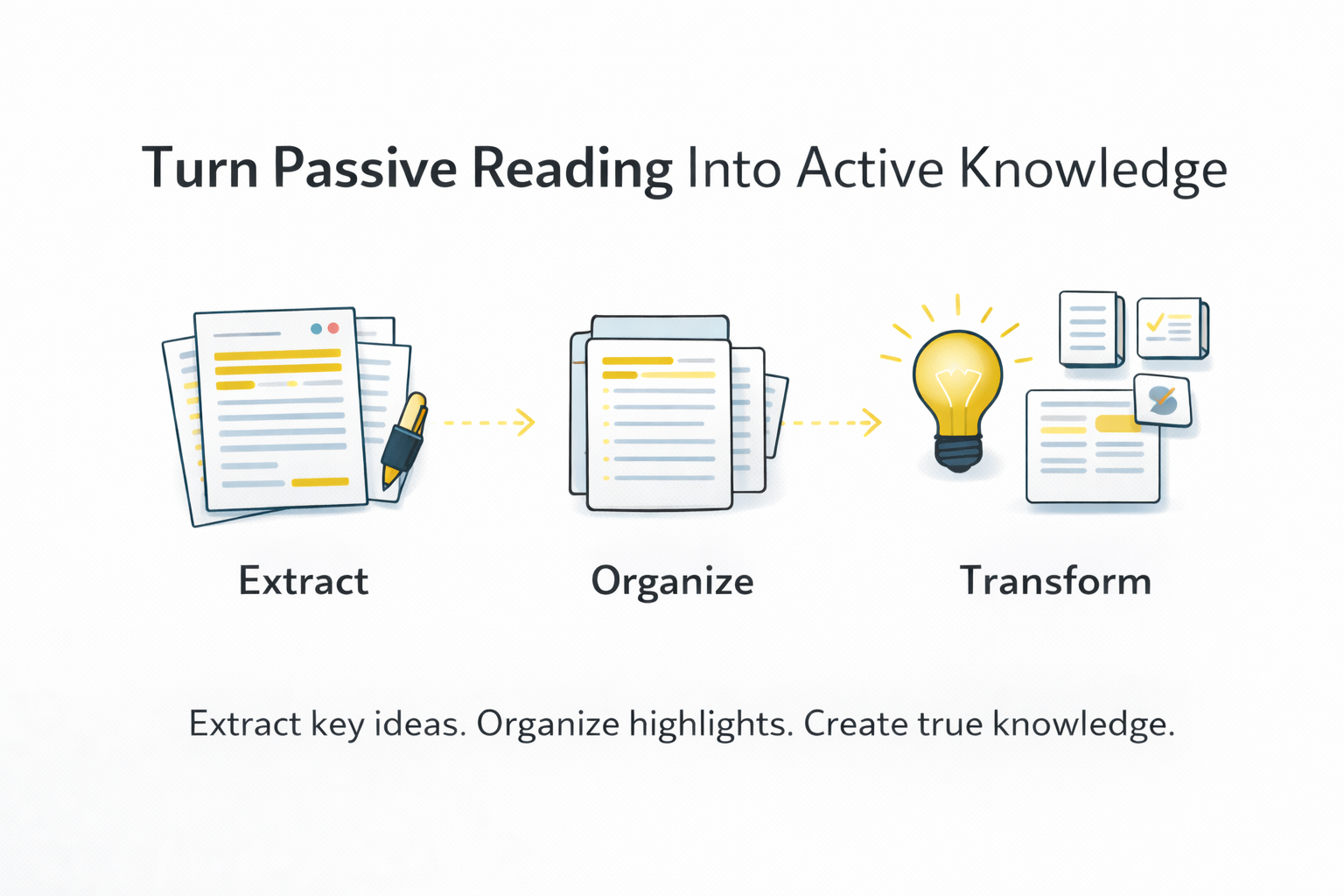
Instead of leaving your highlights scattered, Readoku helps you:
- Extract and organize key ideas
- Group insights by themes
- Edit and refine your notes
- Build structured knowledge from your reading
It turns passive reading into active learning.
Final Thought
You don’t need more books.
You need a better way to work with what you already read.
Because real learning doesn’t happen when you turn pages—
it happens when you connect, question, and synthesize ideas.
And once you start reading this way, even one article can be more valuable than ten books.
Try Readoku on Your Next PDF
Extract Highlights from PDF with Readoku → to pull out your highlighted text, comments, and color-coded annotations quickly. Explore more: How to Extract Highlights from PDF Online and Reading with AI: Is It Good or Bad for Readers and Researchers?.