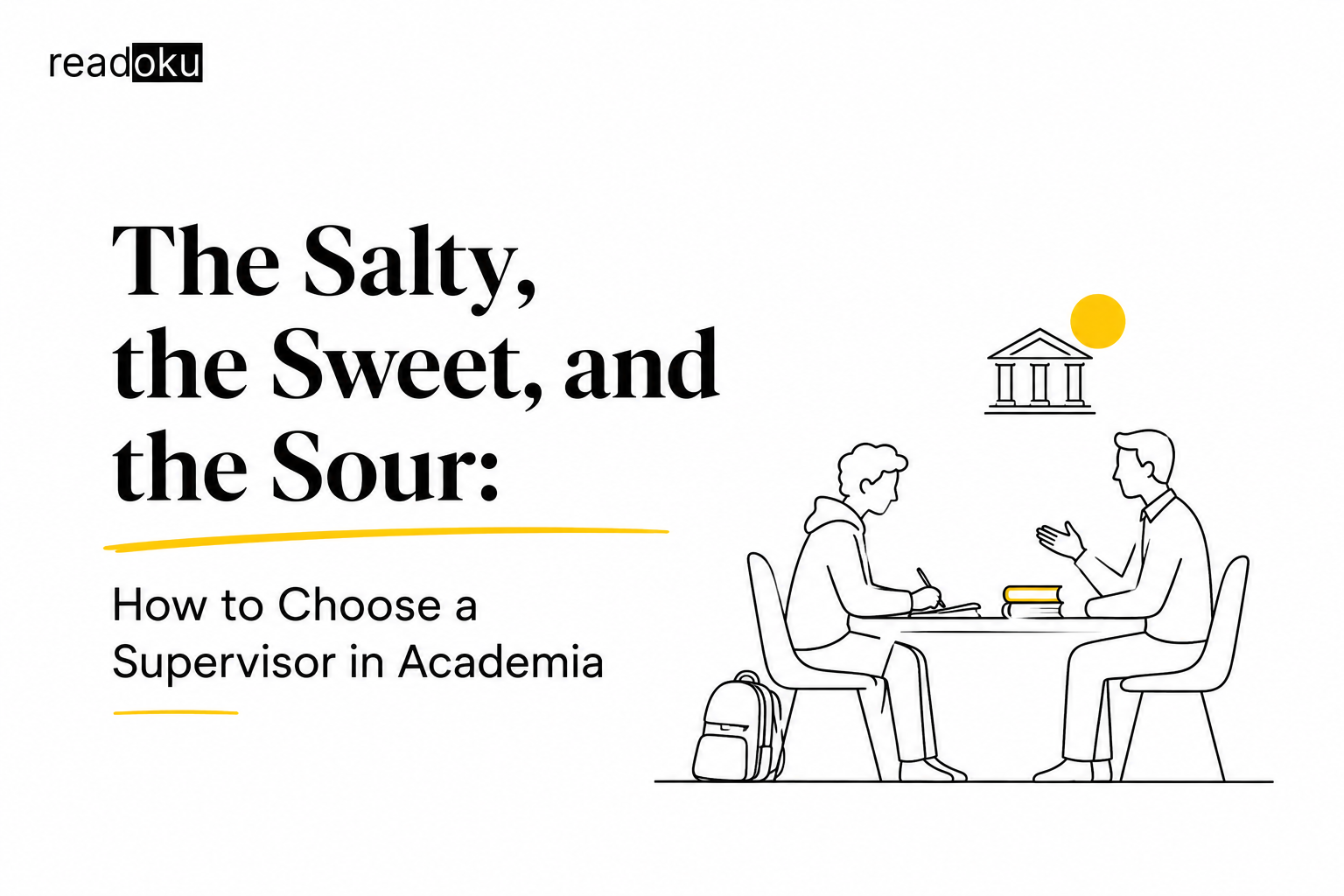
Throughout my journey in academia, I had different supervisors, studied at different universities, and experienced departments across different countries.
And from this experience, I can say something very clearly:
Every department has its own ideology.
Its own atmosphere.
Its own way of working.
Its own politics.
But there is one factor that can completely change the entire experience:
Your supervisor.
No matter what culture dominates the department, your supervisor can shape your daily experience, your confidence, your opportunities, and even your future in academia.
A good supervisor can make a difficult environment survivable.
A bad supervisor can make even a prestigious institution unbearable.
The Sweet Supervisor
I experienced what I call the sweet.
Respectful professors. Mature collaboration. Minimal gossip. Even when disagreements existed between academics, they protected the students from unnecessary politics and maintained professionalism.
There, my supervisor was not someone who controlled every step.
Instead, they:
- motivated me
- believed in me
- defended me
- referred me
- encouraged my ideas
- pushed me to try new things
This was one of the most important academic experiences I ever had.
Not because I was constantly guided.
But because I was trusted.
And honestly, trust changes everything in academia.
When someone believes in your potential, you start believing in it too.
The Sour Supervisor
Then came the sour.
A department atmosphere built around hierarchy, excessive authority, and what I call the “yes ma’am / yes sir” culture.
There was less openness to students from different universities, backgrounds, or perspectives.
In these environments, both the department culture and the supervisor often aim to maintain control rather than growth.
Critical thinking becomes dangerous.
Creativity becomes a threat.
Independence becomes something to suppress rather than encourage.
You end up learning only what the dominant professor already knows.
Not because there is nothing else to explore, but because adding to it can feel like challenging authority.
And this is where many students slowly stop thinking boldly.
Not because they lack intelligence.
But because the environment punishes intellectual independence.
The Salty Supervisor
And then there is the salty.
The department where groups, alliances, and academic “gangs” are formed.
It can take years before you understand who is aligned with whom, who collaborates with whom, and who is silently competing against whom.
In these spaces, supervisors are often balancing multiple roles:
- guiding students
- protecting their projects
- securing funding
- navigating internal politics
- competing with colleagues
Sometimes, with luck, you may still find the right person for you within this chaos.
But the experience can feel exhausting because academia becomes less about research and more about survival strategies.
So… How Do You Choose a Supervisor?
Honestly?
You probably do not choose only one.
Throughout academia, you will likely need different types of supervisors and mentors at different stages.
But initially, you need one very important thing:
Someone who truly believes in you.
Someone who academically adopts you.
Especially in the early years, you need a supervisor who:
- guides you on methods
- teaches you how research actually works
- opens doors
- introduces opportunities
- gives feedback seriously
- treats your growth as important
One of the strongest indicators of a supportive supervisor is simple:
They publish with their students.
They invest in their students.
They genuinely care about their students’ development.
Because academia is difficult enough already.
A self-centered professor who only sees students as labor will help very little—or not at all.
But You Also Need the Difficult One
Surprisingly, one of the most important supervisors you may encounter is the one who challenges you.
The one who:
- criticizes you heavily
- limits you
- doubts you
- pushes you to your limits
Not because academic toxicity is good.
But because difficult supervisors sometimes force you to become sharper, stronger, and more independent.
They unintentionally push you to:
- build confidence
- defend your ideas
- create your own network
- stop depending on validation
And eventually, this becomes essential.
Because at the end of the day, academia requires you to find your own path.
Your own name.
Your own voice.
Your own intellectual identity.
Final Thoughts
A supervisor can shape years of your life.
So before choosing a university, look carefully at:
- how professors treat students
- whether students publish
- whether students speak openly
- whether collaboration exists
- whether criticism is constructive or humiliating
- whether students grow—or simply obey
Prestige alone means very little if the environment slowly destroys your confidence.
And remember:
The goal is not to become a copy of your supervisor.
The goal is to eventually become yourself.
If you are in academia, what is the golden advice you would share with students choosing a supervisor?
Share it with us through the contact form.
And if we receive one or more responses, we will feature them in the next post.
Keep Your Thesis & Research Readings Organized
Working on a thesis or dissertation? Use the Readoku PDF Highlight Extractor → to extract, organize, and cite highlights from all your academic papers in one place. Explore more academic guides: Thesis Writing Tricks That Actually Work and How to Conduct a Systematic Literature Review.