Most thesis advice says "find a gap in the literature" and stops there. That is the hard part. You read twenty papers, everything seems already studied, and the one idea you had turns out to be in a 2019 article you hadn't opened yet.
The good news: gaps are rarely hidden. Authors announce them in their own words, usually in sections titled "Limitations", "Future research" or "Directions for further study". The trick is to collect those sentences systematically instead of hoping to remember them.
Here is a 4-step framework for doing exactly that, based on research into how literature reviews identify gaps.
What counts as a research gap?
A research gap is a question that existing research has not answered well. That can mean it was never studied, studied only in one setting or with one method, or studied with contradictory results.
Sandberg and Alvesson analysed how researchers construct research questions and found that most do it by "gap-spotting" (Organization, 2011). They describe three basic modes:
- Confusion spotting: studies disagree, and you try to explain why.
- Neglect spotting: an area is overlooked, under-researched or lacks empirical support.
- Application spotting: a theory or perspective has not yet been applied to a field.
These three types give you a vocabulary for describing your gap.
The 4-step framework: localize, characterize, verify, present
Müller-Bloch and Kranz analysed 40 published literature reviews and derived a framework with four components for identifying research gaps rigorously (ICIS 2015 Proceedings). Here is how to apply it to a master's or PhD thesis.
Step 1: Localize – collect every candidate gap
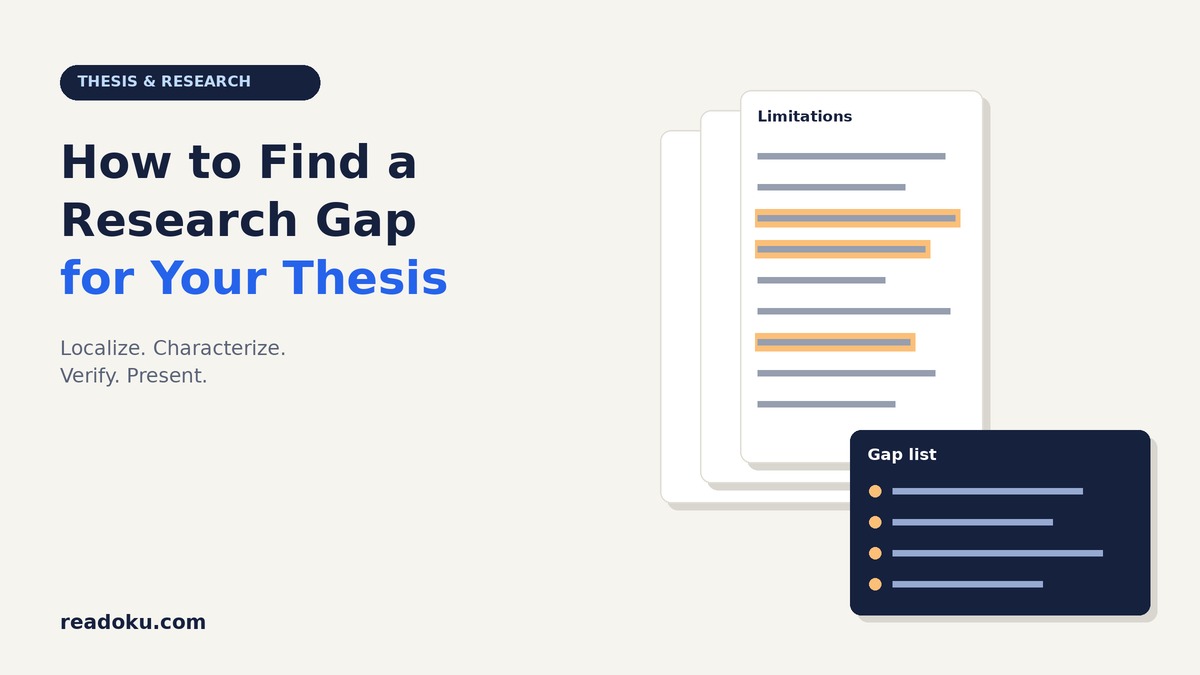
Read your core papers and mark every sentence that signals something unanswered. The University of Chicago Library suggests watching for phrases like "further research is required", "has not been studied" or "limitations".
Use one highlight colour only for these sentences, for example orange. If you already colour-code by function, add it to your scheme (see the 4-color PDF highlighting system for research papers).
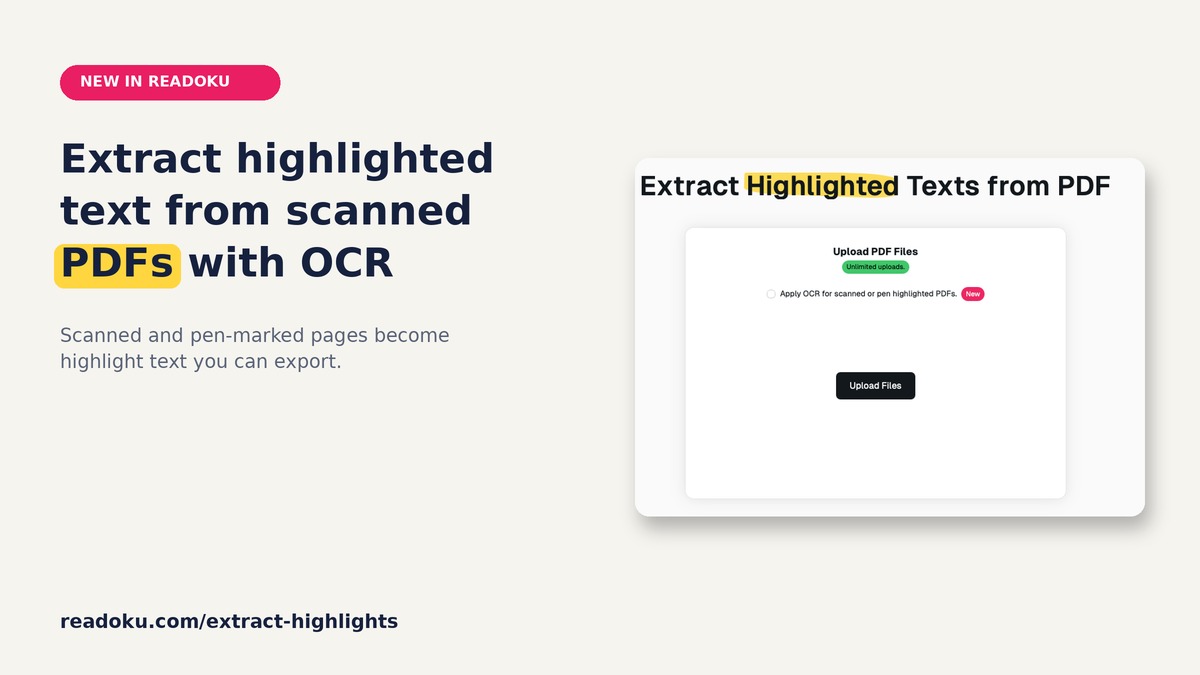
Then pull those sentences out of the PDFs. In Readoku you can filter highlights by color, so you export only the orange sentences from each paper, with page numbers. Paste them into one document: your gap list. After 20 papers, you have every limitation and future-research note in one place, each with its source.
Step 2: Characterize – sort the gaps by type
Now read your gap list and label each entry. Is it confusion (contradictory findings), neglect (missing population, setting, or evidence) or application (an unused theory or method)?
If five papers say "our sample was limited to undergraduates in the US", that is a neglect gap about population and context. If two papers report opposite effects, that is a confusion gap.
A literature review matrix helps here: add a "gap type" column next to method, sample and findings.
Step 3: Verify – check the gap is still open
A future-research note from 2016 may have been answered since. Müller-Bloch and Kranz stress verification because most reviews are not exhaustive, so overlooked papers might show the gap is already closed.
For each promising gap:
- Search the key terms from the gap sentence plus the population or method you would add.
- Check newer work that cites the original paper ("cited by" in your database).
- Ask your supervisor or a subject librarian whether they know of recent studies.
If the gap holds, note the date you checked. If not, cross it off.
Step 4: Present – write the gap statement
Your gap statement should be traceable: a reader can follow it back to the sources. A simple structure:
What we know (with citations) → what remains unclear (with citations) → why it matters → what this thesis asks.
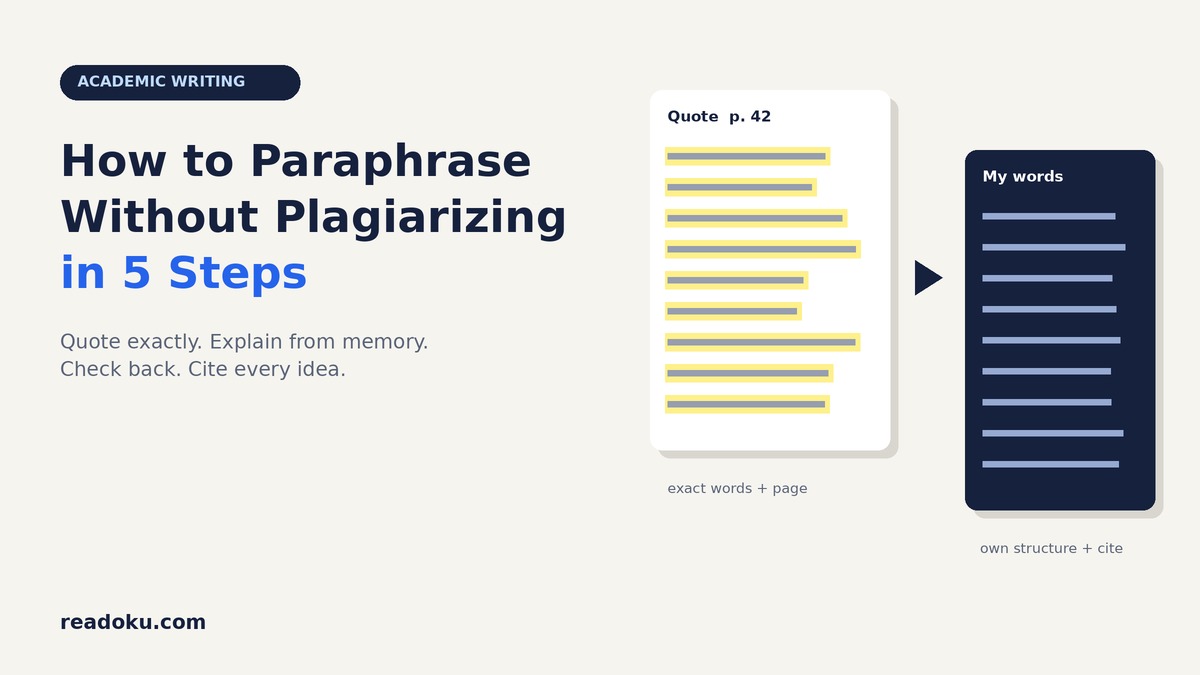
Because every entry in your gap list already carries the author and page, citing the limitations you build on is quick. If you rewrite those sentences in your own words, our guide on how to paraphrase without plagiarizing shows how to stay close to the meaning without copying the wording.
Beyond gap-spotting: try problematization
Sandberg and Alvesson argue that gap-spotting tends to produce incremental questions. Their alternative is problematization: identify an assumption that a body of research takes for granted and ask what happens if it is wrong.
You can use your gap list for this too. Look for what all the papers assume: the same definition, the same type of participant, the same causal direction. A question that challenges a shared assumption is often more interesting than one more extension to a new sample.
A worked example
Imagine a master's student researching remote work and employee wellbeing.
- Localize: across 20 papers she highlights 34 limitation and future-research sentences in orange and exports them into one gap list.
- Characterize: most entries are neglect gaps: samples are mainly office workers in large firms. Three papers report conflicting effects on loneliness: a confusion gap.
- Verify: a forward citation search turns up no study explaining the loneliness conflict for small firms.
- Present: "Studies disagree on whether remote work increases loneliness (A; B; C), and none has examined employees of small firms. This thesis asks…"
(The numbers here are illustrative, not findings.)
Quick checklist
- One highlight colour for limitations and future-research sentences
- One exported gap list, every entry with author and page
- Each gap labelled: confusion, neglect or application
- Each gap verified with a recent search, date noted
- A gap statement your reader can trace to sources
- One shared assumption you could question
Build your gap list today
Finding a research gap is less about inspiration and more about collecting evidence carefully. Highlight limitation and future-research sentences in one colour, then export only that colour with page numbers.
Try colour-filtered highlight export with Readoku and turn your PDFs into one gap list with sources.