Your supervisor wants a short summary of a key paper by Friday. You read the PDF twice and still end up copying half the abstract.
Summarizing a research paper is a skill, not a talent. This guide gives you a five-step method that starts with the highlights you already make and ends with a clean 150-word summary in your own words, ready for a seminar, an annotated bibliography, or a literature review.
Why Summaries Help (When You Do Them Right)
Summarizing is one of eight learning strategies reviewed by Fiorella and Mayer (2016) in their work on generative learning: you select what matters, organize it, and connect it to what you already know.
There is a catch. The large review of study techniques by Dunlosky and colleagues (2013) rated summarization as low utility overall, largely because many learners have not been taught how to summarize well, and a weak summary that copies wording or misses the main point does little. The lesson is not "skip summaries". It is: learn a method. That is what the five steps below are for.
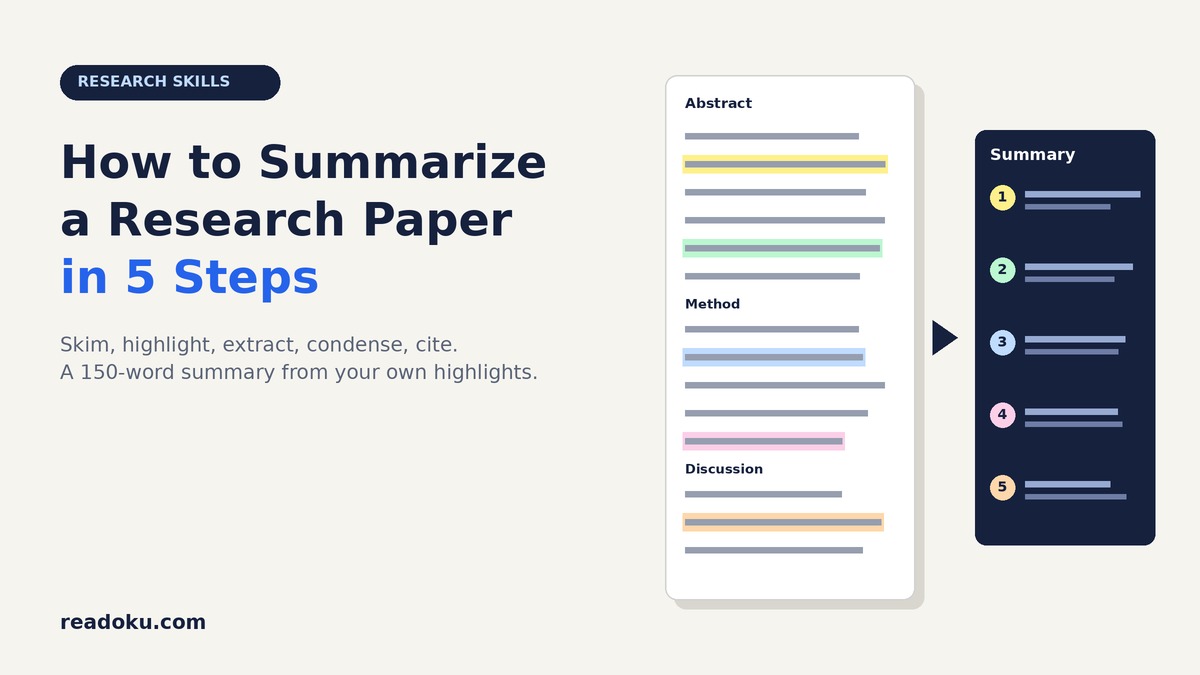
How to Summarize a Research Paper in 5 Steps
Step 1: Skim with the AIC method
Before reading line by line, read the Abstract, Introduction, and Conclusion. Political scientist Raul Pacheco-Vega calls this the AIC technique. The introduction usually tells you the context, the gap, and the contribution; the conclusion tells you what the authors think they found. He stresses that AIC is an overview, not a substitute for reading the middle of the paper.
Step 2: Highlight with five questions in mind
Now read the full paper and highlight only sentences that answer one of these questions:
- Question: What problem or research question does the paper address?
- Method: Who or what was studied, and how?
- Findings: What were the main results?
- Meaning: How do the authors interpret them?
- Limits: What do they say the study cannot show?
If a sentence answers none of them, leave it unmarked. Fewer, sharper highlights make the next steps much faster. A simple color system helps you see the categories at a glance.
Step 3: Pull your highlights into one list
Scrolling back through 20 pages to find your marks is where summaries stall. Collect every highlight in one place, with its page number. You can upload the annotated PDF to Readoku's highlight extractor and get your highlights as a single list with pages, which becomes the skeleton of your summary.
Step 4: Condense each highlight into your own words
Close the PDF. For each highlight, write one short note in your own words, without looking at the original sentence. If you cannot, reread only that section. Writing from memory turns the summary into a small retrieval exercise, not a copying exercise.
Step 5: Draft, cite, and check
Arrange your notes in the order question, method, findings, meaning, limits, and write them as connected prose of about 150 words. Add an in-text citation (see the APA in-text citation guide). Then reopen the paper once to check every claim against your page numbers. Put any phrase you keep word for word in quotation marks with a page reference.
A Worked Example
Take a classic paper on memory: Roediger and Karpicke (2006), "Test-Enhanced Learning". Five highlights, one per question, might become these notes:
- Question: Does taking a test improve memory more than restudying?
- Method: Students read prose passages, then either restudied them or took free-recall tests; final test after 5 minutes, 2 days, or 1 week.
- Findings: Restudying won at 5 minutes; testing won on the delayed tests.
- Meaning: Tests are a learning tool, not just a measurement tool.
- Limits: Prose passages in a lab setting; transfer to other materials needs checking.
Note that the last point is the reader's own critical note, not a limitation quoted from the paper. Keep those two apart in your summary.
Drafted as prose:
Roediger and Karpicke (2006) asked whether taking memory tests improves long-term retention more than restudying. In two experiments, students read short prose passages and then either restudied them or took free-recall tests without feedback, followed by a final test after five minutes, two days, or one week. Restudying produced better recall on the immediate test, but prior testing produced clearly better retention on the delayed tests, even though restudying made students more confident. The authors conclude that testing is a way to learn, not only to assess learning. Because the materials were short passages, it is worth checking how well the effect extends to longer, more complex texts.
That is about 110 words, written from notes, with a citation and a clear line between the authors' claims and the reader's own comment.
Common Mistakes to Avoid
- Summarizing the abstract. It is compressed and often leaves out methods and limits.
- Changing the authors' meaning. Keep your own evaluation clearly separate.
- Skipping the limits. One honest sentence on limitations makes your summary more accurate.
- Patchwriting. Swapping a few words in the original sentence is still too close. Write from your notes.
Where Your Summaries Go Next
One good summary per paper adds up. Ten of them become the core of a literature review; with a sentence on relevance, each becomes an entry in an annotated bibliography. For a structured overview across papers, try a literature review matrix. If reading speed is your bottleneck, these smart reading tricks help, and if you are studying from textbooks rather than papers, see the previous guide in this series: How to Turn Textbook PDF Highlights into Active-Recall Study Notes.
Try it with your next paper: upload one annotated research PDF to Readoku's PDF Highlight Extractor, get your highlights in one list with page numbers, and draft your 150-word summary from the export today.